
Battery Passport Market Report 2026
Global Outlook – By Technology (Blockchain Based Battery Passport, Cloud Based Battery Passport, Internet Of Things And Artificial Intelligence Integrated Battery Passport, Other Technologies), By Battery Type (Lithium Ion, Lead Acid, Sodium Ion, Other Battery Types), By Compliance (European Union Battery Regulation Compliant Batteries, Batteries Under Pilot Schemes, Non Compliant Or Legacy Batteries), By Industry (Automotive, Energy And Utility, Off-Highway Or Industrial, Other Industries) – Market Size, Trends, Strategies, and Forecast to 2035
Battery Passport Market Overview
• Battery Passport market size has reached to $0.11 billion in 2025 • Expected to grow to $0.46 billion in 2030 at a compound annual growth rate (CAGR) of 34.2% • Growth Driver: Rapid Electric Vehicle Adoption Fueling The Market Growth Due To Growing Demand For Battery Transparency • Market Trend: Blockchain-Enabled Battery Passport Platforms Driving Lifecycle Transparency And Traceability • Europe was the largest region in 2025 and Asia-Pacific is the fastest growing region.
What Is Covered Under Battery Passport Market?
A battery passport is a digital record that stores standardized information about a battery throughout its lifecycle, including raw material sourcing, manufacturing, carbon footprint, performance, and end-of-life management. It improves transparency, traceability, and sustainability across the battery value chain. Additionally, it supports regulatory compliance, especially in the electric vehicle and energy storage sectors, while enabling efficient recycling and promoting circular economy practices. The main technology types of battery passport are blockchain based battery passport, cloud based battery passport, internet of things and artificial intelligence integrated battery passport, and other technologies. Blockchain based battery passport refers to a secure digital system that uses distributed ledger technology to record, track, and verify battery lifecycle data, ensuring transparency, traceability, and tamper-proof information sharing. These solutions are categorized by battery type, including lithium ion, lead acid, sodium ion, and other battery types. They are classified based on compliance, such as European Union battery regulation compliant batteries, batteries under pilot schemes, and non-compliant or legacy batteries, and are applied across multiple industries, including automotive, energy and utility, off-highway or industrial, and other industries.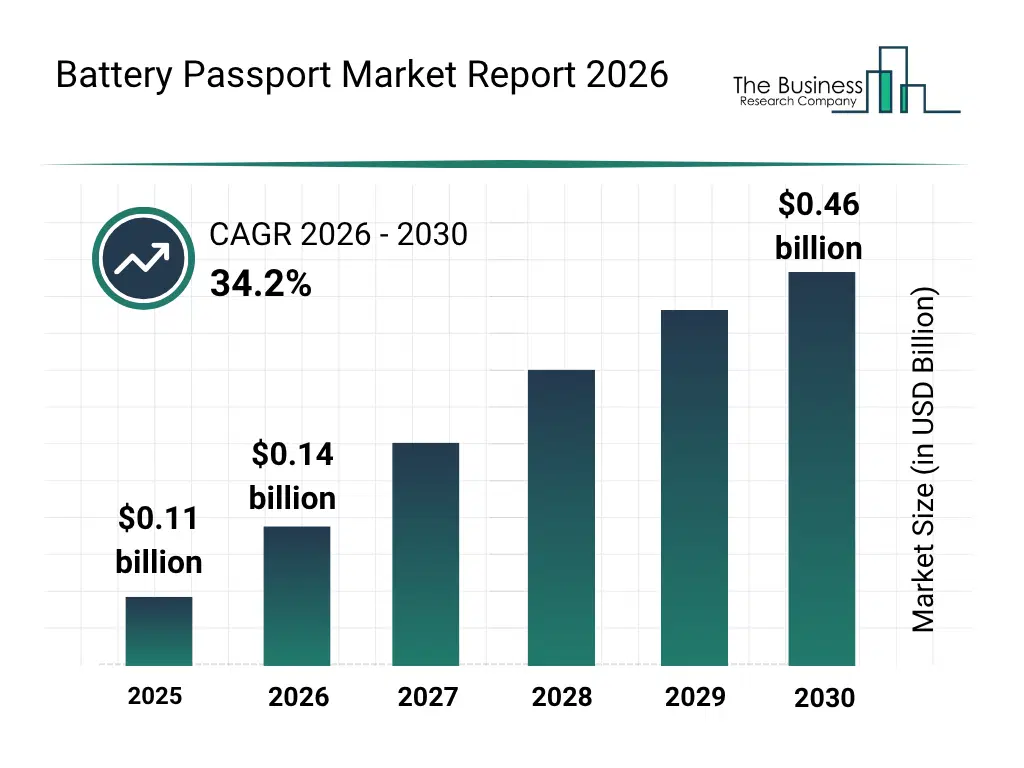
What Is The Battery Passport Market Size and Share 2026?
The battery passport market size has grown exponentially in recent years. It will grow from $0.11 billion in 2025 to $0.14 billion in 2026 at a compound annual growth rate (CAGR) of 33.9%. The growth in the historic period can be attributed to increasing electric vehicle adoption, rising concerns over battery supply chain transparency, regulatory push for battery lifecycle tracking in europe, growth of lithium-ion battery manufacturing, emergence of basic digital traceability systems.What Is The Battery Passport Market Growth Forecast?
The battery passport market size is expected to see exponential growth in the next few years. It will grow to $0.46 billion by 2030 at a compound annual growth rate (CAGR) of 34.2%. The growth in the forecast period can be attributed to implementation of mandatory eu battery passport regulations, expansion of ai-driven battery analytics platforms, widespread adoption of blockchain traceability systems, integration with electric vehicle fleet management ecosystems, global push for circular economy compliance frameworks. Major trends in the forecast period include increasing standardization of battery lifecycle data reporting formats, rising adoption of digital product passport interoperability frameworks, growing integration of compliance reporting with regulatory authorities, expansion of end-of-life battery recycling coordination platforms, rising demand for cross-border battery data exchange systems.Global Battery Passport Market Segmentation
1) By Technology: Blockchain Based Battery Passport, Cloud Based Battery Passport, Internet Of Things And Artificial Intelligence Integrated Battery Passport, Other Technologies 2) By Battery Type: Lithium Ion, Lead Acid, Sodium Ion, Other Battery Types 3) By Compliance: European Union Battery Regulation Compliant Batteries, Batteries Under Pilot Schemes, Non Compliant Or Legacy Batteries 4) By Industry: Automotive, Energy And Utility, Off-Highway Or Industrial, Other Industries Subsegments: 1) By Blockchain Based Battery Passport: Distributed Ledger Battery Tracking Systems, Smart Contract Based Battery Lifecycle Management Platforms, Decentralized Battery Data Verification Systems, Immutable Battery Supply Chain Traceability Platforms, Tokenized Battery Asset Management Systems 2) By Cloud Based Battery Passport: Cloud Hosted Battery Data Management Platforms, Cloud Based Battery Lifecycle Monitoring Systems, Scalable Battery Compliance And Reporting Platforms, Remote Battery Performance Analytics Systems, Centralized Battery Information Storage And Retrieval Platforms 3) By Internet Of Things And Artificial Intelligence Integrated Battery Passport: Internet Of Things Enabled Battery Condition Monitoring Systems, Artificial Intelligence Driven Battery Performance Prediction Platforms, Internet Of Things Sensor Based Battery Usage Tracking Systems, Artificial Intelligence Based Battery Health Diagnostics Platforms, Integrated Internet Of Things And Artificial Intelligence Battery Lifecycle Optimization Systems 4) By Other Technologies: Digital Twin Based Battery Lifecycle Management Systems, Edge Computing Enabled Battery Data Processing Platforms, Application Programming Interface Integrated Battery Data Exchange Platforms, Battery Sustainability And Carbon Footprint Tracking Systems, Advanced Battery Identification And Authentication PlatformsWhat Is The Driver Of The Battery Passport Market?
The increasing adoption of electric vehicles worldwide is expected to propel the growth of the battery passport market going forward. An electric vehicle (EV) is a vehicle that runs on electricity using electric motors and rechargeable batteries instead of a traditional internal combustion engine, resulting in lower fuel use and reduced emissions. Electric vehicle (EV) adoption is increasing mainly due to rising fuel costs, making traditional petrol and diesel vehicles more expensive to operate. Battery passport supports electric vehicles (EVs) by enabling transparent tracking of battery origin, lifecycle data, carbon footprint, and recycling information that helps regulators and manufacturers manage EV battery sustainability and compliance. For instance, in April 2023, according to the International Energy Agency (IEA), a France-based intergovernmental energy organization, electric car sales are projected to remain strong in 2023, with over 2.3 million units sold in the first quarter, marking an increase of around 25% compared to the same period last year. Therefore, the increasing adoption of electric vehicles worldwide is driving the growth of the battery passport industry.Key Players In The Global Battery Passport Market
Major companies operating in the battery passport market are Ford Motor Company, Bayerische Motoren Werke AG, Tesla Inc., Siemens AG, BASF SE, International Business Machines Corporation, Contemporary Amperex Technology Co. Limited, SAP SE, LG Energy Solution Ltd., Umicore SA, AUDI AG, Samsung SDI Co. Ltd., EVE Energy Co. Ltd., AVL List GmbH, Farasis Energy (Ganzhou) Co. Ltd., OPTEL Group Inc., CALB Co. Ltd., Circulor Ltd., ACCURE Battery Intelligence GmbH, RCS Global GmbH, Minespider GmbH, Sunwoda Electronic Co. Ltd., Everledger Ltd., Shenzhen FinDreams Battery Co. Ltd.Global Battery Passport Market Trends and Insights
Major companies operating in the battery passport market are focusing on developing advanced digital battery passport solutions to enhance lifecycle traceability and ensure regulatory compliance. A digital battery passport solution is a platform that captures and monitors a battery’s complete lifecycle data, such as its origin, materials, performance, and end-of-life handling, to enhance transparency, regulatory compliance, and sustainability across the supply chain. For instance, in August 2025, Tata Technologies Limited, an India-based digital services company for engineering and product development, launched WATTSync, a digital battery passport solution that enables seamless battery data management and lifecycle traceability across the electric vehicle ecosystem. WATTSync offers end-to-end battery traceability by digitally tracking batteries throughout their entire lifecycle, from raw material mining to recycling. It enables secure and transparent data sharing among stakeholders, supporting regulatory compliance while enhancing sustainability insights and circular economy practices in the battery value chain.What Are Latest Mergers And Acquisitions In The Battery Passport Market?
In April 2025, Powin LLC, a US-based energy storage integrator, partnered with Circulor to enhance battery supply chain transparency. Through this partnership, Powin and Circulor aim to enhance supply chain transparency and sustainability by leveraging advanced battery traceability solutions to enable responsible sourcing and full lifecycle visibility. Circulor Ltd. is a UK-based provider of a battery passport solution.Regional Insights
Europe was the largest region in the battery passport market in 2025. Asia-Pacific is expected to be the fastest-growing region in the forecast period. The regions covered in this market report are Asia-Pacific, South East Asia, Western Europe, Eastern Europe, North America, South America, Middle East, Africa. The countries covered in this market report are Australia, Brazil, China, France, Germany, India, Indonesia, Japan, Taiwan, Russia, South Korea, UK, USA, Canada, Italy, Spain.What Defines the Battery Passport Market?
The battery passport market consists of revenues earned by entities by providing services such as battery data tracking and management, lifecycle monitoring, digital identification and documentation of battery materials, compliance reporting, and data sharing platforms that enable transparency, traceability, and sustainability across the battery value chain. The market value includes the value of related goods sold by the service provider or included within the service offering. The battery passport market also includes sales of digital battery identity tags, lifecycle tracking platforms, and recycling optimization systems. Values in this market are ‘factory gate’ values, that is, the value of goods sold by the manufacturers or creators of the goods, whether to other entities (including downstream manufacturers, wholesalers, distributors, and retailers) or directly to end customers. The value of goods in this market includes related services sold by the creators of the goods.How is Market Value Defined and Measured?
The market value is defined as the revenues that enterprises gain from the sale of goods and/or services within the specified market and geography through sales, grants, or donations in terms of the currency (in USD unless otherwise specified). The revenues for a specified geography are consumption values that are revenues generated by organizations in the specified geography within the market, irrespective of where they are produced. It does not include revenues from resales along the supply chain, either further along the supply chain or as part of other products.What Key Data and Analysis Are Included in the Battery Passport Market Report 2026?
The battery passport market research report is one of a series of new reports from The Business Research Company that provides market statistics, including industry global market size, regional shares, competitors with the market share, detailed market segments, market trends and opportunities, and any further data you may need to thrive in the battery passport industry. The market research report delivers a complete perspective of everything you need, with an in-depth analysis of the current and future state of the industry.Battery Passport Market Report Forecast Analysis
| Report Attribute | Details |
|---|---|
| Market Size Value In 2026 | $0.14 billion |
| Revenue Forecast In 2035 | $0.46 billion |
| Growth Rate | CAGR of 33.9% from 2026 to 2035 |
| Base Year For Estimation | 2025 |
| Actual Estimates/Historical Data | 2020-2025 |
| Forecast Period | 2026 - 2030 - 2035 |
| Market Representation | Revenue in USD Billion and CAGR from 2026 to 2035 |
| Segments Covered | Technology, Battery Type, Compliance, Industry |
| Regional Scope | Asia-Pacific, Western Europe, Eastern Europe, North America, South America, Middle East, Africa |
| Country Scope | The countries covered in the report are Australia, Brazil, China, France, Germany, India, ... |
| Key Companies Profiled | Ford Motor Company, Bayerische Motoren Werke AG, Tesla Inc., Siemens AG, BASF SE, International Business Machines Corporation, Contemporary Amperex Technology Co. Limited, SAP SE, LG Energy Solution Ltd., Umicore SA, AUDI AG, Samsung SDI Co. Ltd., EVE Energy Co. Ltd., AVL List GmbH, Farasis Energy (Ganzhou) Co. Ltd., OPTEL Group Inc., CALB Co. Ltd., Circulor Ltd., ACCURE Battery Intelligence GmbH, RCS Global GmbH, Minespider GmbH, Sunwoda Electronic Co. Ltd., Everledger Ltd., Shenzhen FinDreams Battery Co. Ltd. |
| Customization Scope | Request for Customization |
| Pricing And Purchase Options | Explore Purchase Options |