

Baggage Handling System Global Market Opportunities And Strategies To 2035
By Type (Destination Coded Vehicle (DCV) Systems, Conveyor), By Technology (Radio-Frequency Identification (RFID), Barcode Technology, Other Technologies), By Mode (Airport, Railway, Marine), By Application (Check-In Systems, Security Screening Systems, Sorting Systems, Transfer Systems, Arrival And Reclaim Systems), And By Region, Opportunities And Strategies – Global Forecast To 2035
Baggage Handling System Market Definition
Baggage handling system (BHS) is an automated system used to transport, sort, track, and screen passenger baggage from check-in to loading, and from arrival to baggage claim. It consists of conveyors, sorters, scanners, control software, and security screening equipment designed to handle large volumes of luggage efficiently. The primary purpose of a baggage handling system is to ensure the safe, accurate, and timely movement of baggage while meeting security requirements. The baggage handling system market consists of sales by entities (organizations, sole traders and partnerships) of baggage handling system that is designed to improve operational efficiency, reduce manual handling, enhance safety and ensure timely baggage delivery in high-traffic, multimodal passenger transport environments.
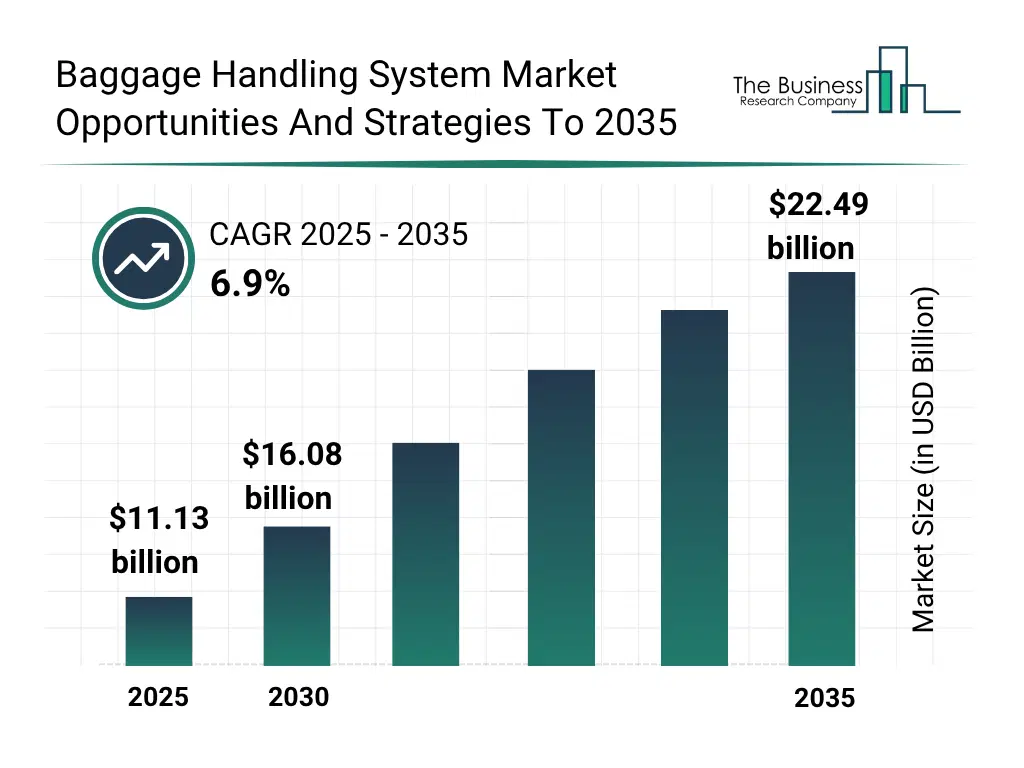
Baggage Handling System Market Size
The global baggage handling system market reached a value of nearly $11,125.6 million in 2025, having grown at a compound annual growth rate (CAGR) of 9.5% since 2020. The market is expected to grow from $11,125.6 million in 2025 to $16,076.6 million in 2030 at a rate of 7.6%. The market is then expected to grow at a CAGR of 6.9% from 2030 and reach $22,492.5 million in 2035. Growth in the historic period resulted from the increasing air passenger traffic, rising demand for seamless travel experiences, adoption of automation and robotics and demand for flexible and scalable baggage handling solutions. Factors that negatively affected growth in the historic period were high initial capital investment and expensive long-term maintenance. Going forward, the increasing investments in airport expansion projects, growing adoption of RFID and real time tracking, growing e-commerce and cargo volumes and expansion of the tourism industry will drive the growth. Factors that could hinder the growth of the baggage handling system market in the future include increasing cybersecurity compliance costs, legacy IT and interoperability gaps and impact of trade war and tariffs.Baggage Handling System Market Segmentation
The baggage handling system market is segmented by type, by technology, by mode and by application.By Type –
The baggage handling system market is segmented by type into:
- a) Destination Coded Vehicle (DCV)
- b) Conveyor
By Technology –
The baggage handling system market is segmented by technology into:
- a) Radio-Frequency Identification (RFID)
- b) Barcode Technology
- c) Other Technologies
By Mode –
The baggage handling system market is segmented by mode into:
- a) Airport
- b) Railway
- c) Marine
By Application –
The baggage handling system market is segmented by application into:
- a) Check-In Systems
- b) Security Screening Systems
- c) Sorting Systems
- d) Transfer Systems
- e) Arrival And Reclaim Systems
By Geography - The baggage handling system market is segmented by geography into:
- • China
- • India
- • Japan
- • Australia
- • Indonesia
- • South Korea
- • USA
- • Canada
- • Brazil
- • France
- • Germany
- • UK
- • Italy
- • Spain
- • Russia
-
o Asia Pacific
o Africa