
Autonomous Robot Toys Market Report 2026
Global Outlook – By Type (Solar Powered, Battery Powered, Other Types), By Educational Role (Tele Presence, Educational Support Tools, Educational Subject), By Functional Ability (Autonomous Navigation, Environmental Perception, Task Perception, Task Performance, Self Maintenance, Other Functional Abilities), By Age Group (5 To 10 Years, 10 To 15 Years, Above 15 Years), By Distribution Channel (Online, Offline6) By Application (Educational, Entertainment, Other Applications) – Market Size, Trends, Strategies, and Forecast to 2035
Autonomous Robot Toys Market Overview
• Autonomous Robot Toys market size has reached to $4.96 billion in 2025 • Expected to grow to $10.4 billion in 2030 at a compound annual growth rate (CAGR) of 16% • Growth Driver: Growing Demand For Interactive And Smart Play Experiences Driving The Market Growth Due To Increasing Digital Engagement Among Children • Market Trend: Strategic Partnerships Drive Innovation And Market Expansion In Autonomous Robot Toys • North America was the largest region in 2025 and Asia-Pacific is the fastest growing region.
What Is Covered Under Autonomous Robot Toys Market?
Autonomous robot toys are smart robotic devices designed for children that can function independently using built-in sensors, artificial intelligence, and programmable software. They interact with users and their surroundings through technologies such as machine learning, voice recognition, computer vision, and IoT connectivity, enabling adaptive responses, storytelling, educational activities, and entertainment without constant human control. The main types of autonomous robot toys include solar-powered, battery-powered, and other variants. Solar-powered robots are specialized toys designed to operate using solar energy, offering interactive and educational experiences while promoting sustainability and energy awareness. These toys fulfill various educational roles, including telepresence, educational support tools, and subject-based learning, and are equipped with multiple functional capabilities such as autonomous navigation, environmental perception, task perception, task performance, self-maintenance, and others. They are designed for different age groups, including 5 to 10 years, 10 to 15 years, and above 15 years, and are distributed through both online and offline channels. Their applications span educational, entertainment, and other use cases.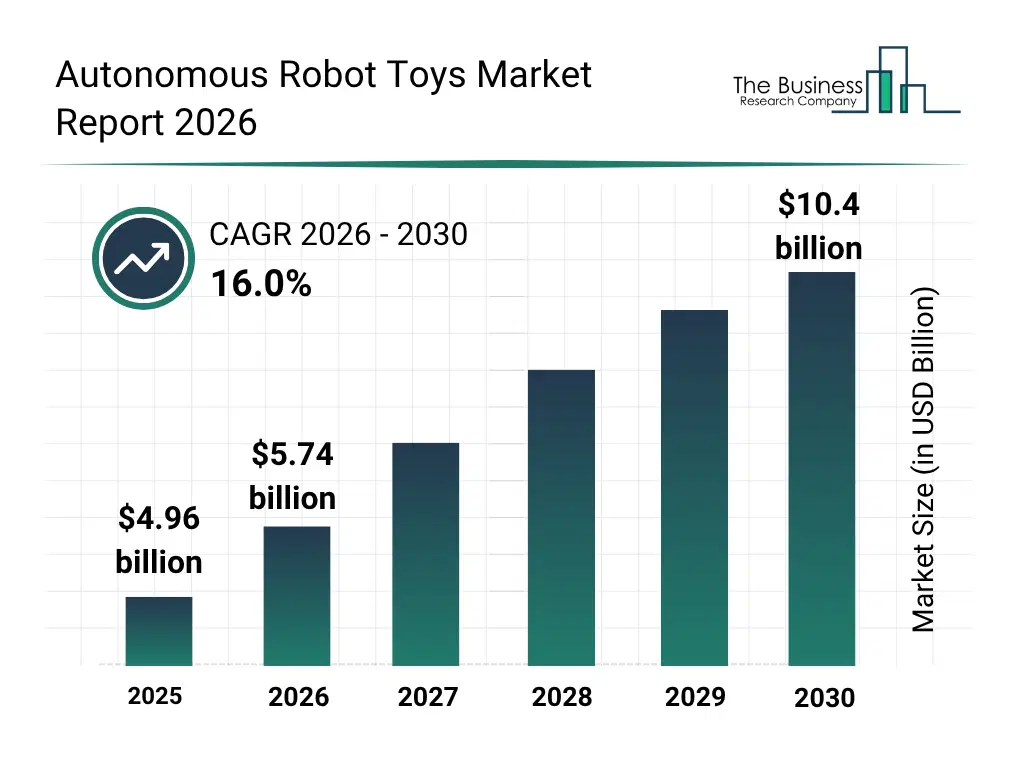
What Is The Autonomous Robot Toys Market Size and Share 2026?
The autonomous robot toys market size has grown rapidly in recent years. It will grow from $4.96 billion in 2025 to $5.74 billion in 2026 at a compound annual growth rate (CAGR) of 15.8%. The growth in the historic period can be attributed to rising demand for educational toys, increasing adoption of electronic toys among children, growth in early STEM learning initiatives, expansion of battery-powered toy robotics, increasing affordability of smart consumer electronics.What Is The Autonomous Robot Toys Market Growth Forecast?
The autonomous robot toys market size is expected to see rapid growth in the next few years. It will grow to $10.4 billion by 2030 at a compound annual growth rate (CAGR) of 16.0%. The growth in the forecast period can be attributed to rising integration of ai in consumer toys, growing demand for personalized learning experiences, expansion of smart home and connected toy ecosystems, increasing adoption of subscription-based educational content platforms, advancement in low-cost sensors and robotics components. Major trends in the forecast period include increasing adoption of voice-interactive learning features in robot toys, rising demand for ai-driven adaptive storytelling capabilities, growing integration of computer vision for gesture and object recognition, expansion of programmable educational robotics kits for children, increasing use of cloud-connected apps for remote robot control and updates.Global Autonomous Robot Toys Market Segmentation
1) By Type: Solar Powered, Battery Powered, Other Types 2) By Educational Role: Tele Presence, Educational Support Tools, Educational Subject 3) By Functional Ability: Autonomous Navigation, Environmental Perception, Task Perception, Task Performance, Self Maintenance, Other Functional Abilities 4) By Age Group: 5 To 10 Years, 10 To 15 Years, Above 15 Years 5) By Distribution Channel: Online, Offline 6) By Application: Educational, Entertainment, Other Applications Subsegments: 1) By Solar Powered: Solar Panel Integrated Toys, Hybrid Solar And Rechargeable Toys, Outdoor Solar Exploration Toys, Solar Powered Educational Robot Kits, Solar Powered Animal Shaped Robots, Solar Powered Humanoid Robots, Solar Powered Vehicle Robots, Solar Powered Do It Yourself Robot Kits 2) By Battery Powered: Rechargeable Battery Operated Robots, Replaceable Battery Operated Robots, Lithium Ion Battery Robots, Nickel Metal Hydride Battery Robots, Remote Controlled Robot Toys, App Controlled Robot Toys, Programmable Robot Toys, Interactive Voice Response Robot Toys, Artificial Intelligence Enabled Robot Toys 3) By Other Types: Crank Powered Robot Toys, Wind Up Mechanical Robot Toys, Capacitor Powered Robot Toys, Hydrogen Fuel Cell Robot Toys, Hybrid Energy Powered Robot Toys, Plug In Electric Robot Toys, Magnetic Induction Powered Robot Toys, Steam Powered Educational Robot ToysWhat Is The Driver Of The Autonomous Robot Toys Market?
The growing demand for interactive and smart play experiences is expected to propel the growth of the autonomous robot toys market going forward. Interactive and smart play experiences refer to technology-driven engagements that use artificial intelligence, voice recognition, and adaptive learning to create personalized and responsive play environments for children. Growing demand for interactive and smart play experiences is rising due to the increasing early exposure of children to digital technologies, which creates expectations for responsive, intelligent, and technology-enabled toys that mimic modern digital interactions. Interactive and smart play experiences shift, compelling manufacturers to develop autonomous robot toys embedded with AI and interactive capabilities that can adapt to a child's behavior, making playtime both stimulating and educational. For instance, in March 2023, according to the Office of Communications (Ofcom), a UK-based independent government-approved regulatory authority for broadcasting and telecommunications, the proportion of children aged 3–17 in the United Kingdom who engage in gaming rose from 6 in 10 in 2022 to 9 in 10 in 2023, reflecting a sharp increase in children's appetite for interactive digital experiences. Therefore, the growing demand for interactive and smart play experiences is driving the growth of the autonomous robot toys industry.Key Players In The Global Autonomous Robot Toys Market
Major companies operating in the autonomous robot toys market are LEGO A/S, Mattel Inc., Hasbro Inc., SZ DJI Technology Co. Ltd., VTech Holdings Limited, Spin Master Corp., UBTECH Robotics Corp. Ltd., Sphero Inc., Makeblock Co. Ltd., Robosen Robotics Shenzhen Co. Ltd., Silverlit Toys Manufactory Ltd., Evollve Inc., Fischertechnik GmbH, RoboThink Inc., Wonder Workshop Inc., Parallax Inc., Hanson Robotics Limited, Blue Frog Robotics SAS, Robotical Ltd., Robobloq Co. Ltd., Modular Robotics Inc., Robo Wunderkind GmbH, Elephant Robotics Co. Ltd., Robots in Schools Ltd.Global Autonomous Robot Toys Market Trends and Insights
Major companies operating in the autonomous robot toys market are focusing on adopting strategic partnerships to expand product innovation and strengthen their market presence. A strategic partnership is a cooperative arrangement between two or more organizations to combine resources, knowledge, or technologies to achieve shared business goals and drive long-term growth. For instance, in March 2025, Robosen Robotics (Shenzhen) Co., Ltd., a China-based robotics technology company, partnered with Hasbro, a US-based toy and entertainment company, to launch a new self-transforming Bumblebee robot toy, featuring automatic conversion from a Volkswagen Beetle to robot mode, voice activation with over 200 lines by original G1 voice actor Dan Gilvezan, and advanced tech like 31 servo motors and app-based customization. The toy is available for preorder at a promotional price of $949 (rising to $1,299 afterward).What Are Latest Mergers And Acquisitions In The Autonomous Robot Toys Market?
In February 2023, Spin Master Corp., a Canada-based provider of children’s entertainment products, toys, and digital games, acquired the HEXBUG brand from Innovation First International, Inc. for an undisclosed amount. Through this acquisition, Spin Master aims to enhance its creative robotic toy offerings by integrating HEXBUG’s robotic technology and expanding its portfolio of interactive and innovative toys. HEXBUG is a US-based company that provides robotic toy products featuring nature-inspired movement and play experiences.Regional Insights
North America was the largest region in the autonomous robot toys market in 2025. Asia-Pacific is expected to be the fastest-growing region in the forecast period. The regions covered in this market report are Asia-Pacific, South East Asia, Western Europe, Eastern Europe, North America, South America, Middle East, Africa. The countries covered in this market report are Australia, Brazil, China, France, Germany, India, Indonesia, Japan, Taiwan, Russia, South Korea, UK, USA, Canada, Italy, Spain.What Defines the Autonomous Robot Toys Market?
The autonomous robot toys market consists of sales of AI-enabled robotic toys, programmable educational robots, interactive storytelling robots, companion robots for children, and robotics kits. Values in this market are ‘factory gate’ values, that is, the value of goods sold by the manufacturers or creators of the goods, whether to other entities (including downstream manufacturers, wholesalers, distributors, and retailers) or directly to end customers. The value of goods in this market includes related services sold by the creators of the goods.How is Market Value Defined and Measured?
The market value is defined as the revenues that enterprises gain from the sale of goods and/or services within the specified market and geography through sales, grants, or donations in terms of the currency (in USD unless otherwise specified). The revenues for a specified geography are consumption values that are revenues generated by organizations in the specified geography within the market, irrespective of where they are produced. It does not include revenues from resales along the supply chain, either further along the supply chain or as part of other products.What Key Data and Analysis Are Included in the Autonomous Robot Toys Market Report 2026?
The autonomous robot toys market research report is one of a series of new reports from The Business Research Company that provides market statistics, including industry global market size, regional shares, competitors with the market share, detailed market segments, market trends and opportunities, and any further data you may need to thrive in the autonomous robot toys industry. The market research report delivers a complete perspective of everything you need, with an in-depth analysis of the current and future state of the industry.Autonomous Robot Toys Market Report Forecast Analysis
| Report Attribute | Details |
|---|---|
| Market Size Value In 2026 | $5.74 billion |
| Revenue Forecast In 2035 | $10.4 billion |
| Growth Rate | CAGR of 15.8% from 2026 to 2035 |
| Base Year For Estimation | 2025 |
| Actual Estimates/Historical Data | 2020-2025 |
| Forecast Period | 2026 - 2030 - 2035 |
| Market Representation | Revenue in USD Billion and CAGR from 2026 to 2035 |
| Segments Covered | Type, Educational Role, Functional Ability, Age Group, Distribution Channel, Application |
| Regional Scope | Asia-Pacific, Western Europe, Eastern Europe, North America, South America, Middle East, Africa |
| Country Scope | The countries covered in the report are Australia, Brazil, China, France, Germany, India, ... |
| Key Companies Profiled | LEGO A/S, Mattel Inc., Hasbro Inc., SZ DJI Technology Co. Ltd., VTech Holdings Limited, Spin Master Corp., UBTECH Robotics Corp. Ltd., Sphero Inc., Makeblock Co. Ltd., Robosen Robotics Shenzhen Co. Ltd., Silverlit Toys Manufactory Ltd., Evollve Inc., Fischertechnik GmbH, RoboThink Inc., Wonder Workshop Inc., Parallax Inc., Hanson Robotics Limited, Blue Frog Robotics SAS, Robotical Ltd., Robobloq Co. Ltd., Modular Robotics Inc., Robo Wunderkind GmbH, Elephant Robotics Co. Ltd., Robots in Schools Ltd. |
| Customization Scope | Request for Customization |
| Pricing And Purchase Options | Explore Purchase Options |