

Automotive Active Health Monitoring System Global Market Opportunities And Strategies To 2035
By Component (Sensors, Other Components), By Location (Driver Seat, Dashboard), By Deployment (On-Premise, Cloud-Based), By Vehicle (Passenger Vehicle, Commercial Vehicle), By Application (Pulse, Blood Sugar Level, Blood Pressure, Other Applications), And By Region, Opportunities And Strategies – Global Forecast To 2035
Automotive Active Health Monitoring System Market Definition
Automotive active health monitoring systems are in-vehicle technologies that continuously assess the physical and physiological condition of drivers and passengers using sensors, cameras, and software analytics. These systems can monitor parameters such as heart rate, respiration, fatigue, stress, posture, and alertness by leveraging biometric sensors, AI algorithms, and cabin monitoring technologies. The primary purpose of automotive active health monitoring systems is to enhance road safety, comfort, and well-being by detecting health risks or driver impairment in real time. The automotive active health monitoring system market consists of sales by entities (organizations, sole traders, or partnerships) of technologies designed to continuously assess, analyze, and respond to the physiological and cognitive health conditions of vehicle occupants, primarily drivers, in real time, to improve road safety and reduce health-related driving risks.
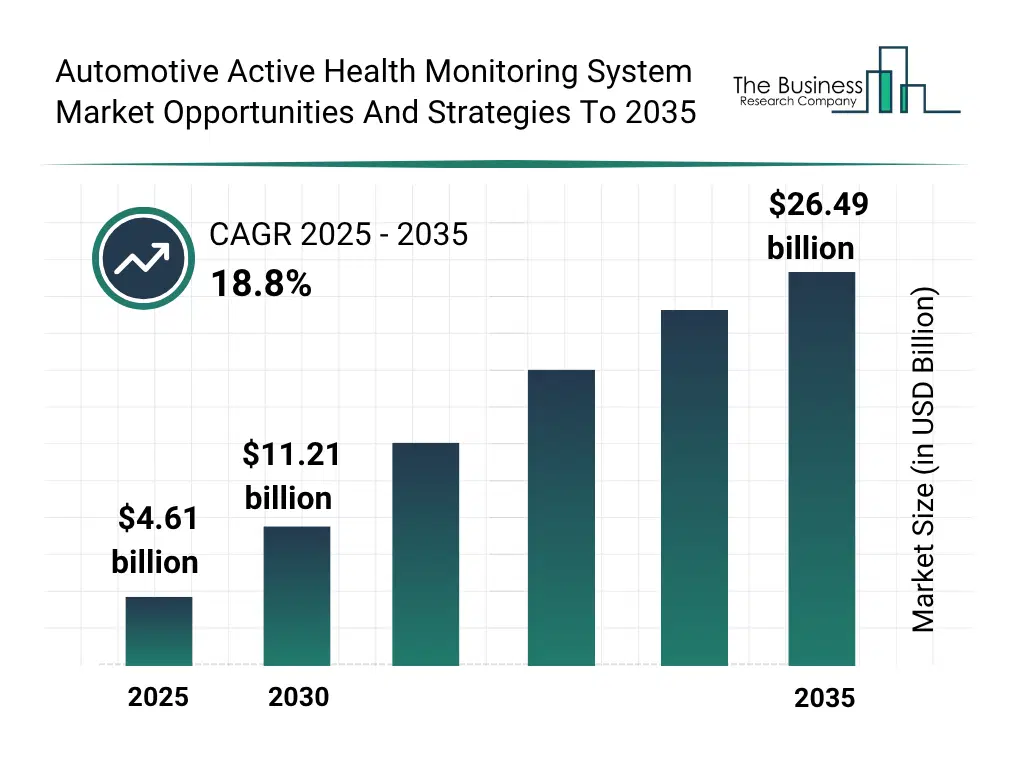
Automotive Active Health Monitoring System Market Size
The global automotive active health monitoring system market reached a value of nearly $4,610.6 million in 2025, having grown at a compound annual growth rate (CAGR) of 20.6% since 2020. The market is expected to grow from $4,610.6 million in 2025 to $11,213.4 million in 2030 at a rate of 19.5%. The market is then expected to grow at a CAGR of 18.8% from 2030 and reach $26,490.2 million in 2035. Growth in the historic period resulted from the growth in shared mobility services, increased focus on road safety, increasing number of road accidents and rise in integration of ai and machine learning in vehicle systems. Factors that negatively affected growth in the historic period were data privacy and cybersecurity concerns and high system integration and implementation costs. Going forward, the increasing vehicle ownership, rising demand for vehicle maintenance and repair services, growth of electric and autonomous vehicles and rise in demand for ADAS will drive the growth. Factors that could hinder the growth of the automotive active health monitoring system market in the future include accuracy and reliability limitations, complex integration with existing vehicle architectures and impact of trade war and tariff.Automotive Active Health Monitoring System Market Segmentation
The automotive active health monitoring system market is segmented by component, by location, by deployment, by vehicle and by application.By Component –
The automotive active health monitoring system market is segmented by component into:
- a) Sensors
- b) Other Components
By Location –
The automotive active health monitoring system market is segmented by location into:
- a) Driver Seat
- b) Dashboard
By Deployment –
The automotive active health monitoring system market is segmented by deployment into:
- a) On-Premise
- b) Cloud-Based
by vehicle –
The automotive active health monitoring system market is segmented by vehicle into:
- a) Passenger Vehicle
- b) Commercial Vehicle
By Application –
The automotive active health monitoring system market is segmented by application into:
- a) Pulse
- b) Blood Sugar Level
- c) Blood Pressure
- d) Other Application
By Geography - The automotive active health monitoring system market is segmented by geography into:
- • China
- • India
- • Japan
- • Australia
- • Indonesia
- • South Korea
- • USA
- • Canada
- • Brazil
- • France
- • Germany
- • UK
- • Italy
- • Spain
- • Russia
-
o Asia Pacific
o Africa