
At-Home Dermatology Devices Market Report 2026
Global Outlook – By Product Type (Light Therapy Devices, Microdermabrasion Devices, Laser Devices, Radiofrequency Devices, Microneedling Devices, Other Product Types), By Distribution Channel (Online Stores, Pharmacies, Specialty Stores, Other Distribution Channels), By Application (Acne Treatment, Hair Removal, Skin Rejuvenation, Wrinkle Reduction, Psoriasis, Other Applications), By End-User (Individuals, Home Care Settings) – Market Size, Trends, Strategies, and Forecast to 2035
At-Home Dermatology Devices Market Overview
• At-Home Dermatology Devices market size has reached to $9.68 billion in 2025 • Expected to grow to $17.7 billion in 2030 at a compound annual growth rate (CAGR) of 12.9% • Growth Driver: Increasing Prevalence Of Skin Related Disorders Driving The Market Growth Due To Higher Incidence Of Chronic Skin Conditions • Market Trend: Revolutionary At-Home Injectable Solutions Enhancing Accessibility, Precision, And Convenience In Dermatologic Treatments • North America was the largest region in 2025 and Asia-Pacific is the fastest growing region.
What Is Covered Under At-Home Dermatology Devices Market?
At-home dermatology devices are tools designed for personal skin care and treatment that allow individuals to monitor, manage, or improve skin health outside of a clinical setting. These devices utilize technologies such as lasers, light therapy, microcurrents, or diagnostic sensors to address conditions like acne, wrinkles, hyperpigmentation, or hair growth. The main product types of at-home dermatology devices include light therapy devices, microdermabrasion devices, laser devices, radiofrequency devices, microneedling devices, and other product types. Light therapy devices refer to devices that use specific wavelengths of light to treat skin conditions such as acne, psoriasis, and signs of aging. These solutions are distributed through online stores, pharmacies, specialty stores, and other distribution channels. They find application in acne treatment, hair removal, skin rejuvenation, wrinkle reduction, psoriasis, and other applications, serving end users including individuals and home care settings.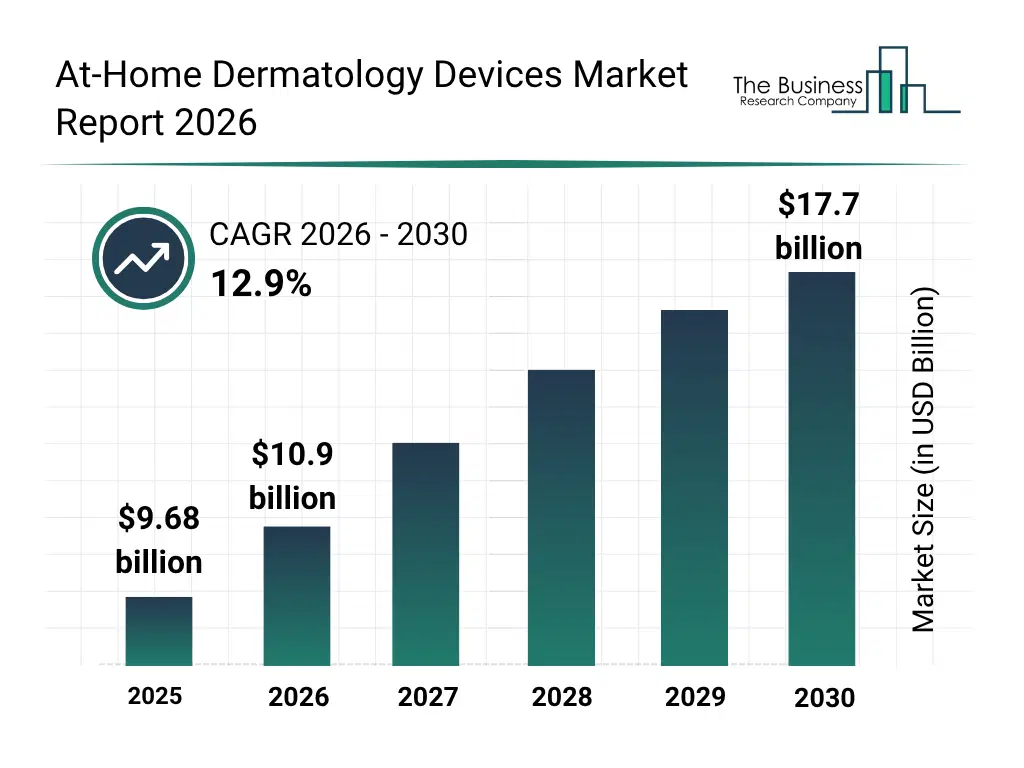
What Is The At-Home Dermatology Devices Market Size and Share 2026?
The at-home dermatology devices market size has grown rapidly in recent years. It will grow from $9.68 billion in 2025 to $10.9 billion in 2026 at a compound annual growth rate (CAGR) of 12.6%. The growth in the historic period can be attributed to rising consumer awareness of skin health, growing demand for anti-aging solutions, increasing popularity of non-invasive home treatments, advancements in laser and light therapy technology, expansion of e-commerce channels for skincare devices.What Is The At-Home Dermatology Devices Market Growth Forecast?
The at-home dermatology devices market size is expected to see rapid growth in the next few years. It will grow to $17.7 billion in 2030 at a compound annual growth rate (CAGR) of 12.9%. The growth in the forecast period can be attributed to increasing integration of AI and diagnostic sensors in devices, rising adoption of personalized skin treatment solutions, growth of online and subscription-based distribution models, expansion of multi-functional and combination therapy devices, increasing focus on safety and regulatory compliance for home-use dermatology tools. Major trends in the forecast period include increasing adoption of portable at-home dermatology devices, rising demand for combination skincare therapy devices, growing integration of light and laser-based treatment devices, expansion of automated microneedling and serum delivery systems, rising focus on online and direct-to-consumer distribution channels.Global At-Home Dermatology Devices Market Segmentation
1) By Product Type: Light Therapy Devices, Microdermabrasion Devices, Laser Devices, Radiofrequency Devices, Microneedling Devices, Other Product Types 2) By Distribution Channel: Online Stores, Pharmacies, Specialty Stores, Other Distribution Channels 3) By Application: Acne Treatment, Hair Removal, Skin Rejuvenation, Wrinkle Reduction, Psoriasis, Other Applications 4) By End-User: Individuals, Home Care Settings Subsegments: 1) By Light Therapy Devices: Blue Light Therapy Devices, Red Light Therapy Devices, Combination Red And Blue Light Therapy Devices, Portable Light Therapy Devices 2) By Microdermabrasion Devices: Crystal-Based Microdermabrasion Devices, Diamond-Tip Microdermabrasion Devices, Handheld Microdermabrasion Devices, Professional-Grade At-Home Microdermabrasion Devices 3) By Laser Devices: Fractional Laser Devices, Non-Ablative Laser Devices, Ablative Laser Devices, Portable At-Home Laser Devices 4) By Radiofrequency Devices: Monopolar Radiofrequency Devices, Bipolar Radiofrequency Devices, Tripolar Radiofrequency Devices, Portable Radiofrequency Skin Devices 5) By Microneedling Devices: Manual Microneedling Rollers, Automated Microneedling Pens, At-Home Microneedling Kits, Combination Microneedling And Serum Devices 6) By Other Product Types: Ultrasonic Skin Devices, Hydration And Infusion Devices, Light Emitting Diode Facial Mask Devices, Combination Skincare Therapy DevicesWhat Is The Driver Of The At-Home Dermatology Devices Market?
The increasing prevalence of skin related disorders is expected to propel the growth of the at home dermatology devices market going forward. Skin related disorders refer to conditions affecting the skin such as eczema, dermatitis, psoriasis, and other chronic or acute inflammatory diseases. The prevalence of skin related disorders is rising due to lifestyle changes such as poor diet, increasing stress, lack of physical activity, and greater exposure to environmental pollutants, which can trigger or worsen conditions such as eczema, acne, and psoriasis. At-home dermatology devices enable individuals to actively manage skin‑related disorders by offering real-time monitoring, personalized treatment application, and progress tracking, reducing dependency on in-person consultations while improving skin health outcomes. For instance, in August 2023, Skin Health Institute Inc., an Australia-based non-profit organization, in Australia, psoriasis affects an estimated 2–3% of the population, highlighting it as a fairly common skin condition. Therefore, the increasing prevalence of skin related disorders is driving the growth of the at home dermatology devices market.Key Players In The Global At-Home Dermatology Devices Market
Major companies operating in the at-home dermatology devices market are Procter & Gamble Co., Panasonic Corporation, L’Oréal S.A., Koninklijke Philips N.V., Nu Skin Enterprises Inc., YA-MAN Ltd., Therabody Inc., FOREO AB, CurrentBody Ltd., Home Skinovations Ltd., Project E Beauty Inc., The Beauty Tech Group Inc., LightStim Inc., Beurer GmbH, PMD Beauty Inc., ZIIP Beauty Inc., Microderm GLO LLC, BSG Aesthetics Solutions Inc., Nood Ventures LLC, Reviva Labs Inc., Kenzzi Limited, Homiley Brands LLC, Nooance Inc.Global At-Home Dermatology Devices Market Trends and Insights
Major companies operating in the At-Home Dermatology Devices market are focusing on developing innovative products such as at-home microneedle injectable devices to provide convenient, effective, and self-administered treatments for common skin conditions. At-home microneedle injectable devices are compact tools that deliver precise doses of medication directly into the skin, helping reduce inflammation, treat acne or other dermatologic conditions, and provide clinic-level results conveniently at home. For instance, in October 2025, Indomo Therapeutics Inc., a US-based clinical-stage company, launched ClearPen, an investigational at-home injectable candidate for treating inflammatory acne lesions. ClearPen combines a proprietary microneedle delivery device with triamcinolone acetonide, a corticosteroid consistent with American Academy of Dermatology guidelines. The device enables precise, low-dose intradermal injections that reduce inflammation and lesion size, allowing patients to self-administer treatment safely at home. Its design emphasizes ease of use, accuracy, and convenience compared with traditional in-office intralesional injections. Beyond acne, Indomo aims to expand the platform for other corticosteroid-responsive conditions, such as keloids and hidradenitis suppurativa, providing broader access to timely dermatologic care.What Are Latest Mergers And Acquisitions In The At-Home Dermatology Devices Market?
In October 2024, CurrentBody Ltd, a UK-based beauty technology company, acquired Tria Beauty, Inc. for an undisclosed amount. With this acquisition, CurrentBody Ltd aims to expand its portfolio of at-home beauty devices and strengthen its leadership in clinically-backed, consumer-friendly aesthetic technologies. Tria Beauty Inc. is a US-based beauty technology company that specializes in developing FDA-approved at-home laser hair removal and skin rejuvenation devices.Regional Insights
North America was the largest region in the at-home dermatology devices market in 2025. Asia-Pacific is expected to be the fastest-growing region in the forecast period. The regions covered in this market report are Asia-Pacific, South East Asia, Western Europe, Eastern Europe, North America, South America, Middle East, Africa. The countries covered in this market report are Australia, Brazil, China, France, Germany, India, Indonesia, Japan, Taiwan, Russia, South Korea, UK, USA, Canada, Italy, Spain.What Defines the At-Home Dermatology Devices Market?
The at-home dermatology devices market consists of sales of handheld skin analyzers, portable acne treatment wands, home use skin tightening and contouring tools. Values in this market are ‘factory gate’ values, that is, the value of goods sold by the manufacturers or creators of the goods, whether to other entities (including downstream manufacturers, wholesalers, distributors, and retailers) or directly to end customers. The value of goods in this market includes related services sold by the creators of the goods.How is Market Value Defined and Measured?
The market value is defined as the revenues that enterprises gain from the sale of goods and/or services within the specified market and geography through sales, grants, or donations in terms of the currency (in USD unless otherwise specified). The revenues for a specified geography are consumption values that are revenues generated by organizations in the specified geography within the market, irrespective of where they are produced. It does not include revenues from resales along the supply chain, either further along the supply chain or as part of other products.What Key Data And Analysis Are Included In The At-Home Dermatology Devices Market Report 2026?
The at-home dermatology devices market research report is one of a series of new reports from The Business Research Company that provides market statistics, including industry global market size, regional shares, competitors with the market share, detailed market segments, market trends and opportunities, and any further data you may need to thrive in the at-home dermatology devices industry. The market research report delivers a complete perspective of everything you need, with an in-depth analysis of the current and future state of the industry.At-Home Dermatology Devices Market Report Forecast Analysis
| Report Attribute | Details |
|---|---|
| Market Size Value In 2026 | $10.9 billion |
| Revenue Forecast In 2035 | $17.7 billion |
| Growth Rate | CAGR of 12.6% from 2026 to 2035 |
| Base Year For Estimation | 2025 |
| Actual Estimates/Historical Data | 2020-2025 |
| Forecast Period | 2026 - 2030 - 2035 |
| Market Representation | Revenue in USD Billion and CAGR from 2026 to 2035 |
| Segments Covered | Product Type, Distribution Channel, Application, End-User |
| Regional Scope | Asia-Pacific, Western Europe, Eastern Europe, North America, South America, Middle East, Africa |
| Country Scope | The countries covered in the report are Australia, Brazil, China, France, Germany, India, Indonesia, Japan, Taiwan, Russia, South Korea, UK, USA, Canada, Italy, Spain. |
| Key Companies Profiled | Procter & Gamble Co., Panasonic Corporation, L’Oréal S.A., Koninklijke Philips N.V., Nu Skin Enterprises Inc., YA-MAN Ltd., Therabody Inc., FOREO AB, CurrentBody Ltd., Home Skinovations Ltd., Project E Beauty Inc., The Beauty Tech Group Inc., LightStim Inc., Beurer GmbH, PMD Beauty Inc., ZIIP Beauty Inc., Microderm GLO LLC, BSG Aesthetics Solutions Inc., Nood Ventures LLC, Reviva Labs Inc., Kenzzi Limited, Homiley Brands LLC, Nooance Inc. |
| Customization Scope | Request for Customization |
| Pricing And Purchase Options | Explore Purchase Options |