
Artificial Intelligence In Neuromorphic Computing Market Report 2026
Global Outlook – By Component (Hardware, Software, Services), By Technology Architecture (Digital Neuromorphic Processors, Analog Neuromorphic Processors, Mixed-Signal Neuromorphic Systems, Spiking Neural Network Hardware, Non-Spiking Artificial Neural Network Accelerators, Synaptic Transistor Arrays, Three-Dimensional Integrated Neuromorphic Systems), By Deployment Mode (Edge Computing, Cloud Computing, Hybrid Computing),By End-User Industry (Consumer Electronics, Automotive And Transportation, Industrial Manufacturing And Robotics, Healthcare And Life Sciences, Aerospace And Defense, Information Technology And Telecommunications, Data Centers And Cloud Service Providers, Research Institutions And Academia) – Market Size, Trends, Strategies, and Forecast to 2035
Artificial Intelligence In Neuromorphic Computing Market Overview
• artificial intelligence In Neuromorphic Computing market size has reached to $2.04 billion in 2025 • Expected to grow to $9.28 billion in 2030 at a compound annual growth rate (CAGR) of 35.4% • Growth Driver: Rising Integration Into Autonomous Vehicles Driving The Market Growth Due To Increasing Demand For Energy-Efficient, Real-Time AI Processing • Market Trend: Innovations In Artificial Intelligence (AI) Hardware Accelerate Scalable And Energy-Efficient Neuromorphic Computing Systems • North America was the largest region in 2025 and Asia-Pacific is the fastest growing region.
What Is Covered Under Artificial Intelligence In Neuromorphic Computing Market?
Artificial intelligence in neuromorphic computing refers to the design and integration of brain-inspired computing architectures that merge AI algorithms with hardware systems modeled on the structure and functionality of the human brain. Its core objective is to improve computational efficiency, lower power consumption, and enable highly parallel data processing for complex cognitive tasks. The main components of artificial intelligence in neuromorphic computing include hardware, software, and services. Hardware refers to specialized computing devices designed to mimic neural architectures for high-efficiency, low-power AI computation. These solutions utilize technology architectures such as digital neuromorphic processors, analog neuromorphic processors, mixed-signal neuromorphic systems, spiking neural network hardware, non-spiking artificial neural network accelerators, synaptic transistor arrays, and three-dimensional integrated neuromorphic systems, and are deployed through edge computing, cloud computing, and hybrid computing models. They find application in image recognition, signal processing, data mining, robotics, edge computing, and other applications, serving end users including consumer electronics, automotive and transportation, industrial manufacturing and robotics, healthcare and life sciences, aerospace and defense, information technology and telecommunications, data centers and cloud service providers, and research institutions and academia.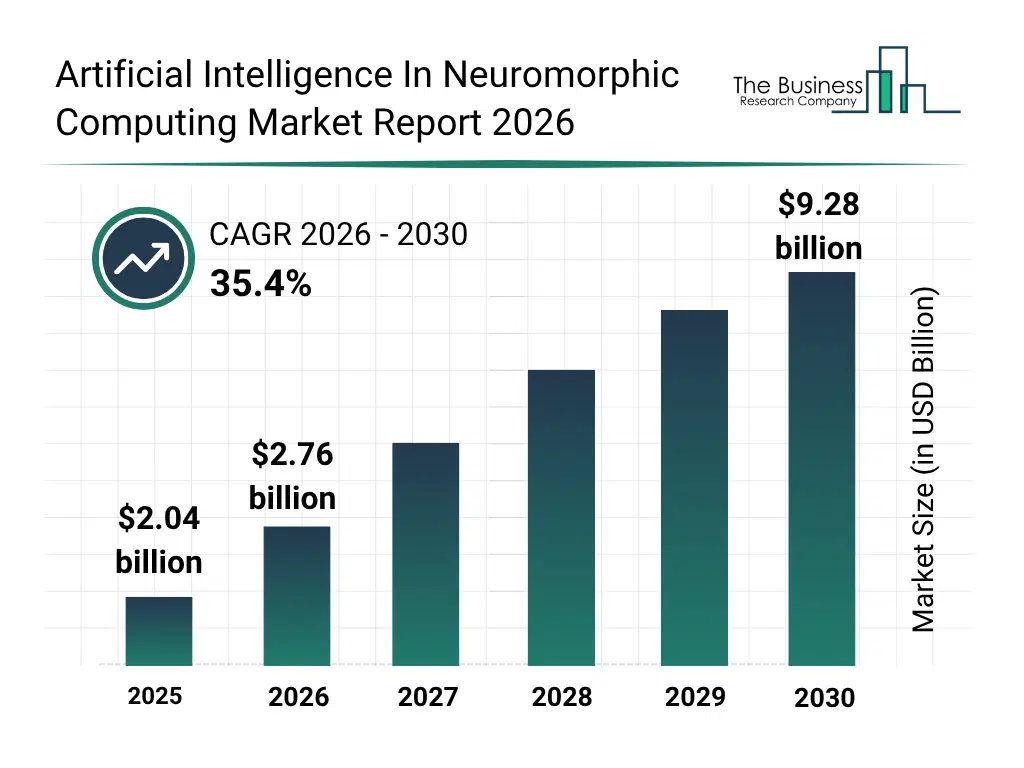
What Is The Artificial Intelligence In Neuromorphic Computing Market Size and Share 2026?
The artificial intelligence in neuromorphic computing market size has grown exponentially in recent years. It will grow from $2.04 billion in 2025 to $2.76 billion in 2026 at a compound annual growth rate (CAGR) of 35.1%. The growth in the historic period can be attributed to increasing research in brain-inspired computing, growing need for low-power AI hardware, rising adoption in consumer electronics, development of custom neuromorphic boards, increasing focus on robotics and automation applications.What Is The Artificial Intelligence In Neuromorphic Computing Market Growth Forecast?
The artificial intelligence in neuromorphic computing market size is expected to see exponential growth in the next few years. It will grow to $9.28 billion in 2030 at a compound annual growth rate (CAGR) of 35.4%. The growth in the forecast period can be attributed to growing deployment in edge and cloud AI systems, increasing demand for industrial manufacturing and robotics applications, rising integration in healthcare and life sciences, expansion in aerospace and defense sectors, growing adoption by data centers and cloud service providers. Major trends in the forecast period include increasing adoption of edge neuromorphic computing, rising demand for spiking neural network hardware, growing integration of neuromorphic memory devices, expansion of hybrid computing deployment models, rising focus on ai-driven image and signal processing applications.Global Artificial Intelligence In Neuromorphic Computing Market Segmentation
1) By Component: Hardware, Software, Services 2) By Technology Architecture: Digital Neuromorphic Processors, Analog Neuromorphic Processors, Mixed-Signal Neuromorphic Systems, Spiking Neural Network Hardware, Non-Spiking Artificial Neural Network Accelerators, Synaptic Transistor Arrays, Three-Dimensional Integrated Neuromorphic Systems 3) By Deployment Mode: Edge Computing, Cloud Computing, Hybrid Computing 4) By Application: Image Recognition, Signal Processing, Data Mining, Robotics, Edge Computing, Other Applications 5) By End-User Industry: Consumer Electronics, Automotive And Transportation, Industrial Manufacturing And Robotics, Healthcare And Life Sciences, Aerospace And Defense, Information Technology And Telecommunications, Data Centers And Cloud Service Providers, Research Institutions And Academia Subsegments: 1) By Hardware: Neuromorphic Processors, Neuromorphic Memory Devices, Sensor Integrated Chips, Edge Artificial Intelligence Hardware, Neuromorphic Accelerators, Custom Neuromorphic Boards 2) By Software: Neuromorphic Algorithm Platforms, Spiking Neural Network Frameworks, Artificial Intelligence Model Development Tools, Simulation And Emulation Software, Data Training And Optimization Software, Middleware For Neuromorphic Systems 3) By Services: Consulting And Strategy Services, System Integration Services, Deployment And Implementation Services, Maintenance And Support Services, Training And Education Services, Managed Artificial Intelligence ServicesWhat Is The Driver Of The Artificial Intelligence In Neuromorphic Computing Market?
The rising integration of autonomous vehicles is expected to propel the growth of artificial intelligence in the neuromorphic computing market going forward. Autonomous vehicle integration refers to the incorporation of advanced AI-driven hardware and software systems directly into self-driving vehicle platforms to enable real-time perception, decision-making, and control. The autonomous vehicles integration is accelerating primarily as autonomous vehicles generate enormous volumes of sensor data that conventional GPU and CPU architectures struggle to process efficiently within the power and latency constraints of onboard systems, compelling the industry to seek brain-inspired computing alternatives. The increasing deployment of autonomous vehicles creates a direct and sustained need for neuromorphic processors, as these chips deliver event-driven, ultra-low-latency computation that enables split-second responses to dynamic road conditions, capabilities that traditional architectures cannot match at the same energy efficiency. For instance, in December 2024, according to the National Highway Traffic Safety Administration, a US-based government agency, by 2030, an estimated 4.5 million self-driving vehicles will operate on U.S. roads. Therefore, the rising integration of autonomous vehicles is driving the growth of artificial intelligence in the neuromorphic computing market.Key Players In The Global Artificial Intelligence In Neuromorphic Computing Market
Major companies operating in the artificial intelligence in neuromorphic computing market are Samsung Electronics Co Ltd, International Business Machines Corporation, Intel Corporation, Qualcomm Incorporated, Hewlett Packard Enterprise Company, SK hynix Inc, Tower Semiconductor Ltd, Axelera AI BV, Rain Neuromorphics Inc, Prophesee SA, SynSense AG, Innatera Nanosystems BV, BrainChip Holdings Limited, General Vision Inc, Applied Brain Research Inc, Knowm Inc, Vivum Computing Inc, Blumind Inc, Numenta Inc, Aspirare Technologies Private Limited, and Grayscale AI Ltd.Global Artificial Intelligence In Neuromorphic Computing Market Trends and Insights
Major companies operating in the artificial intelligence in the neuromorphic computing market are focusing on developing advanced artificial intelligence (AI)-driven hardware architectures to improve energy efficiency, scalability, and high-performance neural processing. Artificial intelligence (AI)-driven hardware architectures are advanced computing frameworks engineered to optimize the execution of AI algorithms through specialized processors, enhanced memory configurations, and high-performance parallel processing. For instance, in April 2024, Intel Corporation, a US-based semiconductor manufacturing company, introduced its Hala Point, a neuromorphic system built on second-generation Loihi processors. Hala Point integrates 1.15 billion neurons, supports scalable rack-level deployment, and delivers significant improvements in energy-efficient processing for large-scale artificial intelligence research. These capabilities strengthen high-performance neuromorphic experimentation and accelerate scalable system design.What Are Latest Mergers And Acquisitions In The Artificial Intelligence In Neuromorphic Computing Market?
In February 2024, SynSense, a Switzerland-based company that provides artificial intelligence capabilities through neuromorphic computing technology, partnered with iniVation AG to advance energy-efficient, brain-inspired artificial intelligence through integrated neuromorphic sensing and computing. The partnership aims to combine event-based vision sensors with neuromorphic processors to deliver ultra-low-power, real-time AI solutions for edge computing and intelligent vision applications. iniVation AG is a Switzerland-based company specializing in event-driven vision sensors and neuromorphic vision systems for advanced AI applications.Regional Insights
North America was the largest region in the artificial intelligence in neuromorphic computing market in 2025. Asia-Pacific is expected to be the fastest-growing region in the forecast period. The regions covered in this market report are Asia-Pacific, South East Asia, Western Europe, Eastern Europe, North America, South America, Middle East, Africa. The countries covered in this market report are Australia, Brazil, China, France, Germany, India, Indonesia, Japan, Taiwan, Russia, South Korea, UK, USA, Canada, Italy, Spain.What Defines the Artificial Intelligence In Neuromorphic Computing Market?
The artificial intelligence in the neuromorphic computing market consists of revenues earned by entities by providing services such as neuromorphic chip design services, semiconductor fabrication services, and system validation services. The market value includes the value of related goods sold by the service provider or included within the service offering. The artificial intelligence in the neuromorphic computing market also includes sales of neuromorphic processors, spiking neural network chips, memristor-based chips, and resistive random access memory devices. Values in this market are ‘factory gate’ values, that is, the value of goods sold by the manufacturers or creators of the goods, whether to other entities, including downstream manufacturers, wholesalers, distributors, and retailers, or directly to end customers. The value of goods in this market includes related services sold by the creators of the goods.How is Market Value Defined and Measured?
The market value is defined as the revenues that enterprises gain from the sale of goods and/or services within the specified market and geography through sales, grants, or donations in terms of the currency (in USD unless otherwise specified). The revenues for a specified geography are consumption values that are revenues generated by organizations in the specified geography within the market, irrespective of where they are produced. It does not include revenues from resales along the supply chain, either further along the supply chain or as part of other products.What Key Data And Analysis Are Included In The Artificial Intelligence In Neuromorphic Computing Market Report 2026?
The artificial intelligence in neuromorphic computing market research report is one of a series of new reports from The Business Research Company that provides market statistics, including industry global market size, regional shares, competitors with the market share, detailed market segments, market trends and opportunities, and any further data you may need to thrive in the artificial intelligence in neuromorphic computing industry. The market research report delivers a complete perspective of everything you need, with an in-depth analysis of the current and future state of the industry.Artificial Intelligence In Neuromorphic Computing Market Report Forecast Analysis
| Report Attribute | Details |
|---|---|
| Market Size Value In 2026 | $2.76 billion |
| Revenue Forecast In 2035 | $9.28 billion |
| Growth Rate | CAGR of 35.1% from 2026 to 2035 |
| Base Year For Estimation | 2025 |
| Actual Estimates/Historical Data | 2020-2025 |
| Forecast Period | 2026 - 2030 - 2035 |
| Market Representation | Revenue in USD Billion and CAGR from 2026 to 2035 |
| Segments Covered | Component, Technology Architecture, Deployment Mode, Application, End-User Industry |
| Regional Scope | Asia-Pacific, Western Europe, Eastern Europe, North America, South America, Middle East, Africa |
| Country Scope | The countries covered in the report are Australia, Brazil, China, France, Germany, India, Indonesia, Japan, Taiwan, Russia, South Korea, UK, USA, Canada, Italy, Spain. |
| Key Companies Profiled | Samsung Electronics Co Ltd, International Business Machines Corporation, Intel Corporation, Qualcomm Incorporated, Hewlett Packard Enterprise Company, SK hynix Inc, Tower Semiconductor Ltd, Axelera AI BV, Rain Neuromorphics Inc, Prophesee SA, SynSense AG, Innatera Nanosystems BV, BrainChip Holdings Limited, General Vision Inc, Applied Brain Research Inc, Knowm Inc, Vivum Computing Inc, Blumind Inc, Numenta Inc, Aspirare Technologies Private Limited, and Grayscale AI Ltd. |
| Customization Scope | Request for Customization |
| Pricing And Purchase Options | Explore Purchase Options |