
Artificial Intelligence (AI) Dermatology Imaging Market Report 2026
Global Outlook – By Component (Software, Hardware, Services), By Imaging Modality (Dermatoscopic Imaging, Clinical Imaging, Reflectance Confocal Microscopy, Optical Coherence Tomography, Total Body Photography, Multispectral Imaging), By Deployment Mode (Cloud-Based, On-Premises), By Application (Disease Diagnosis, Treatment Monitoring, Screening And Triage, Teledermatology, Research Applications), By End User (Dermatology Clinics, Hospitals, Telehealth Platforms, Primary Care Networks, Other End Users) – Market Size, Trends, Strategies, and Forecast to 2035
Artificial Intelligence (AI) Dermatology Imaging Market Overview
• Artificial Intelligence (AI) Dermatology Imaging market size has reached to $1.12 billion in 2025 • Expected to grow to $2.9 billion in 2030 at a compound annual growth rate (CAGR) of 21% • Growth Driver: Increasing Incidence Of Skin Cancer Driving The Market Growth Due To Rising Need For Early Detection And Accurate Diagnosis • Market Trend: Innovations In Artificial Intelligence (AI)-Powered Clinical Imaging Platforms Enhance Diagnostic Accuracy And Efficiency In Dermatology Research • North America was the largest region in 2025 and Asia-Pacific is the fastest growing region.
What Is Covered Under Artificial Intelligence (AI) Dermatology Imaging Market?
Artificial intelligence (AI) dermatology imaging is a technology that applies machine learning algorithms to analyze skin images for diagnostic purposes. It detects, classifies, and monitors various skin conditions by recognizing patterns, textures, and colors that may indicate disease. AI-driven analysis enhances accuracy and efficiency in identifying dermatological abnormalities through automated image interpretation. The main components of artificial intelligence (AI) dermatology imaging include software, hardware, and services. Software refers to platforms that analyze dermatological images using AI algorithms for diagnostic and clinical decision support. The imaging modalities include dermatoscopic imaging, clinical imaging, reflectance confocal microscopy, optical coherence tomography, total body photography, and multispectral imaging. The deployment modes include cloud-based and on-premises solutions. The various applications involved are disease diagnosis, treatment monitoring, screening and triage, teledermatology, and research applications, and are used by several end users such as dermatology clinics, hospitals, telehealth platforms, primary care networks, and other end users.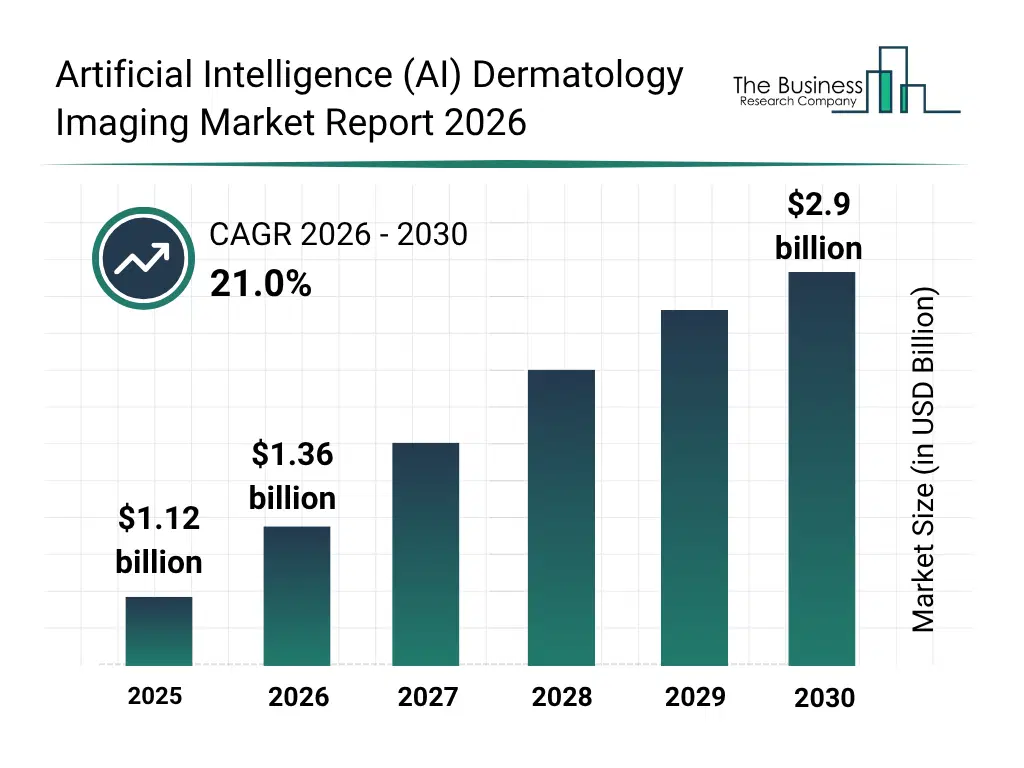
What Is The Artificial Intelligence (AI) Dermatology Imaging Market Size and Share 2026?
The artificial intelligence (AI) dermatology imaging market size has grown exponentially in recent years. It will grow from $1.12 billion in 2025 to $1.36 billion in 2026 at a compound annual growth rate (CAGR) of 20.7%. The growth in the historic period can be attributed to growing prevalence of skin disorders, increasing demand for accurate dermatology diagnosis, adoption of dermatoscopic imaging and clinical imaging, expansion of dermatology clinics and hospital networks, rising interest in telehealth platforms.What Is The Artificial Intelligence (AI) Dermatology Imaging Market Growth Forecast?
The artificial intelligence (AI) dermatology imaging market size is expected to see exponential growth in the next few years. It will grow to $2.9 billion in 2030 at a compound annual growth rate (CAGR) of 21.0%. The growth in the forecast period can be attributed to growing integration of ai-enabled analytics, increasing adoption of cloud-based deployment models, rising demand for automated disease screening and triage, expansion of research applications in dermatology imaging, growing focus on teledermatology and remote patient monitoring. Major trends in the forecast period include increasing adoption of cloud-based ai dermatology platforms, rising demand for multispectral and total body imaging solutions, growing integration of teledermatology services, expansion of ai-enabled treatment monitoring tools, rising focus on workflow automation and data management solutions.Global Artificial Intelligence (AI) Dermatology Imaging Market Segmentation
1) By Component: Software, Hardware, Services 2) By Imaging Modality: Dermatoscopic Imaging, Clinical Imaging, Reflectance Confocal Microscopy, Optical Coherence Tomography, Total Body Photography, Multispectral Imaging 3) By Deployment Mode: Cloud-Based, On-Premises 4) By Application: Disease Diagnosis, Treatment Monitoring, Screening And Triage, Teledermatology, Research Applications 5) By End User: Dermatology Clinics, Hospitals, Telehealth Platforms, Primary Care Networks, Other End Users Subsegments: 1) By Software: Cloud Based Solutions, On Premise Solutions, Artificial Intelligence Enabled Analytics Platforms, Image Processing And Visualization Tools, Data Management And Integration Platforms, Workflow And Reporting Solutions 2) By Hardware: Imaging Devices And Scanners, High Performance Computing Systems, Storage And Data Servers, Display And Visualization Systems, Networking And Connectivity Equipment, Peripheral Input And Output Devices 3) By Services: System Integration And Deployment Services, Maintenance And Technical Support Services, Consulting And Implementation Services, Training And Education Services, Managed And Cloud Hosting Services, Upgradation And Optimization ServicesWhat Is The Driver Of The Artificial Intelligence (AI) Dermatology Imaging Market?
The increasing incidence of skin cancer is expected to propel the growth of the artificial intelligence (AI) dermatology imaging market going forward. Skin cancer refers to the abnormal growth of skin cells, often due to UV radiation exposure, leading to malignant tumors such as melanoma and non-melanoma types. The incidence of skin cancer is rising due to increasing exposure to ultraviolet (UV) radiation from the sun and artificial tanning beds, which damages skin cells and increases the risk of malignant growths. AI in dermatology imaging enhances the early detection and accurate diagnosis of skin cancer by analyzing images of skin lesions with advanced algorithms, identifying subtle patterns and abnormalities that may be missed by the human eye, and enabling faster, more reliable clinical decisions for timely treatment. For instance, in January 2026, according to the Skin Cancer Foundation, a US-based non-profit organization, the number of new melanoma cases diagnosed is projected to rise by 10.6 percent. Therefore, the increasing incidence of skin cancer is driving the growth of the artificial intelligence (AI) dermatology imaging industry.Key Players In The Global Artificial Intelligence (AI) Dermatology Imaging Market
Major companies operating in the artificial intelligence (AI) dermatology imaging market are Google LLC, Microsoft Corporation, Perfect Corp., Canfield Scientific Inc., Proscia Inc., Behold.ai Inc., FotoFinder Systems GmbH, SmartSkin AI Inc., MetaOptima Technology Inc., QuantifiCare SA, SkinVision B.V., DermaSensor Inc., Skin Analytics Ltd, Haut.AI Inc., First Derm Inc., Enspectra Health Inc., SkinIO Inc., SciBase Holding AB, SkinIO LLC, GlamAR Group Inc., IQONIC.AI Inc., TeleSkin d.o.o., DermAI Inc.Global Artificial Intelligence (AI) Dermatology Imaging Market Trends and Insights
Major companies operating in the artificial intelligence (AI) dermatology imaging market are focusing on developing innovative solutions such as AI-powered clinical imaging platforms to enhance diagnostic accuracy, streamline clinical trials, and provide objective, real-time skin assessments. AI-powered clinical imaging platforms are systems that combine advanced skin imaging with artificial intelligence algorithms to automatically capture, analyze, and score dermatological conditions, helping clinicians and researchers obtain faster, more objective, and standardized assessments compared with traditional manual evaluation. For instance, in September 2025, QuantifiCare, a France-based medical imaging company, partnered with Legit.Health, a Spain-based AI healthcare company, to launch the first AI-powered dermatology imaging platform for clinical trials. The platform combines QuantifiCare’s 2D and 3D imaging systems with Legit.Health’s AI algorithms provide immediate severity grading, real-time treatment response insights, and automated scoring of over 300 skin conditions. Key features include standardized imaging workflows, high reproducibility, reduced administrative workload, and enhanced reliability of clinical endpoints, making it a powerful tool for sponsors, CROs, and investigators seeking to accelerate dermatology research.What Are Latest Mergers And Acquisitions In The Artificial Intelligence (AI) Dermatology Imaging Market?
In December 2024, Omda AS, a Norway-based healthcare technology company, acquired Dermicus AB for an undisclosed amount. With this acquisition, Omda aims to enhance its technological capabilities in AI-assisted medical imaging and telemedicine, expand its digital health solutions portfolio, accelerate innovation in remote patient care, and strengthen its competitive position in the Nordic healthcare technology market. Dermicus AB is a Sweden-based healthcare technology company that specializes in AI-enhanced teledermatology, telewound care, and mobile imaging solutions for remote diagnosis and management of skin conditions.Regional Insights
North America was the largest region in the artificial intelligence (AI) dermatology imaging market in 2025. Asia-Pacific is expected to be the fastest-growing region in the forecast period. The regions covered in this market report are Asia-Pacific, South East Asia, Western Europe, Eastern Europe, North America, South America, Middle East, Africa. The countries covered in this market report are Australia, Brazil, China, France, Germany, India, Indonesia, Japan, Taiwan, Russia, South Korea, UK, USA, Canada, Italy, Spain.What Defines the Artificial Intelligence (AI) Dermatology Imaging Market?
The artificial intelligence (AI) dermatology imaging market consists of revenues earned by entities by providing services such as skin lesion detection, mole mapping and monitoring, acne and psoriasis analysis, melanoma risk assessment, early skin cancer screening, automated image-based diagnosis, teledermatology support, and treatment response monitoring. The market value includes the value of related goods sold by the service provider or included within the service offering. The artificial intelligence (AI) dermatology imaging market also includes sales of AI-powered dermoscopy cameras, multispectral skin analysis systems, 3D skin surface scanners, edge-based dermatology diagnostic terminals. Values in this market are ‘factory gate’ values, that is the value of goods sold by the manufacturers or creators of the goods, whether to other entities (including downstream manufacturers, wholesalers, distributors and retailers) or directly to end customers. The value of goods in this market includes related services sold by the creators of the goods.How is Market Value Defined and Measured?
The market value is defined as the revenues that enterprises gain from the sale of goods and/or services within the specified market and geography through sales, grants, or donations in terms of the currency (in USD unless otherwise specified). The revenues for a specified geography are consumption values that are revenues generated by organizations in the specified geography within the market, irrespective of where they are produced. It does not include revenues from resales along the supply chain, either further along the supply chain or as part of other products.What Key Data And Analysis Are Included In The Artificial Intelligence (AI) Dermatology Imaging Market Report 2026?
The artificial intelligence (ai) dermatology imaging market research report is one of a series of new reports from The Business Research Company that provides market statistics, including industry global market size, regional shares, competitors with the market share, detailed market segments, market trends and opportunities, and any further data you may need to thrive in the artificial intelligence (ai) dermatology imaging industry. The market research report delivers a complete perspective of everything you need, with an in-depth analysis of the current and future state of the industry.Artificial Intelligence (AI) Dermatology Imaging Market Report Forecast Analysis
| Report Attribute | Details |
|---|---|
| Market Size Value In 2026 | $1.36 billion |
| Revenue Forecast In 2035 | $2.9 billion |
| Growth Rate | CAGR of 20.7% from 2026 to 2035 |
| Base Year For Estimation | 2025 |
| Actual Estimates/Historical Data | 2020-2025 |
| Forecast Period | 2026 - 2030 - 2035 |
| Market Representation | Revenue in USD Billion and CAGR from 2026 to 2035 |
| Segments Covered | Component, Imaging Modality, Deployment Mode, Application, End User |
| Regional Scope | Asia-Pacific, Western Europe, Eastern Europe, North America, South America, Middle East, Africa |
| Country Scope | The countries covered in the report are Australia, Brazil, China, France, Germany, India, Indonesia, Japan, Taiwan, Russia, South Korea, UK, USA, Canada, Italy, Spain. |
| Key Companies Profiled | Google LLC, Microsoft Corporation, Perfect Corp., Canfield Scientific Inc., Proscia Inc., Behold.ai Inc., FotoFinder Systems GmbH, SmartSkin AI Inc., MetaOptima Technology Inc., QuantifiCare SA, SkinVision B.V., DermaSensor Inc., Skin Analytics Ltd, Haut.AI Inc., First Derm Inc., Enspectra Health Inc., SkinIO Inc., SciBase Holding AB, SkinIO LLC, GlamAR Group Inc., IQONIC.AI Inc., TeleSkin d.o.o., DermAI Inc. |
| Customization Scope | Request for Customization |
| Pricing And Purchase Options | Explore Purchase Options |