
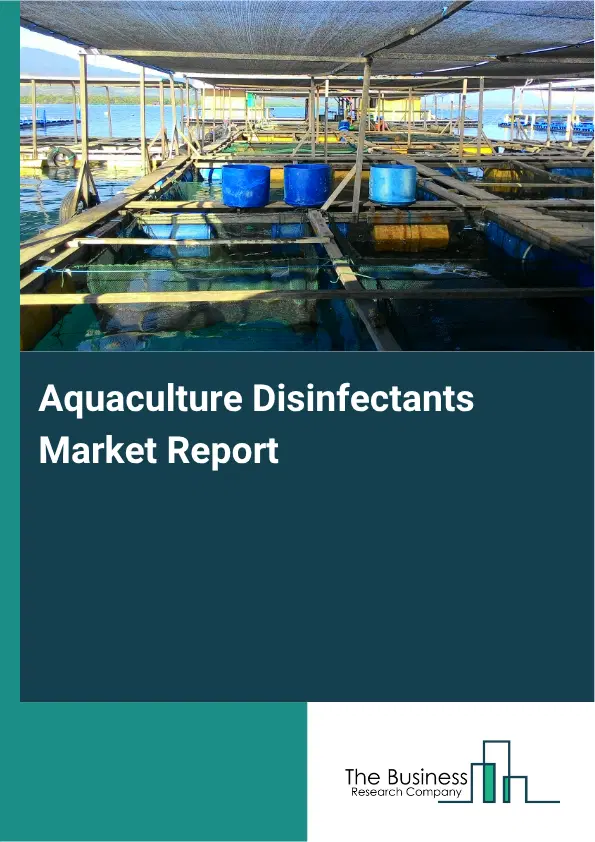
Aquaculture Disinfectants Market Report 2026
Global Outlook – By Type (Oxidizing Disinfectants, Non-Oxidizing Disinfectants, Aldehyde Disinfectants, Halogen Disinfectants, Other Types), By Form (Liquid, Powder, Granular, Other Forms), By Distribution Channel (Direct Sales, Distributors, Online Retail, Other Distribution Channels), By Application (Fish Farming, Shrimp Farming, Mollusk Farming, Other Applications), By End-Use (Commercial Aquaculture, Household And Small-Scale Aquaculture, Research And Educational Institutes, Other End-Uses) – Market Size, Trends, Strategies, and Forecast to 2035
Aquaculture Disinfectants Market Overview
• Aquaculture Disinfectants market size has reached to $1.47 billion in 2025 • Expected to grow to $2.23 billion in 2030 at a compound annual growth rate (CAGR) of 8.7% • Growth Driver: The Increasing Demand For Seafood Is Fueling The Market Growth Due To Rising Health Consciousness • Market Trend: Advancement In Peracetic Acid-Based Biocides For Sustainable Aquaculture Disinfection • Asia-Pacific was the largest region in 2025 and North America is the fastest growing region.
What Is Covered Under Aquaculture Disinfectants Market?
Aquaculture disinfectants are chemical or physical agents used to eliminate or control harmful microorganisms in water, equipment, and facilities involved in fish and shellfish production. They help prevent the spread of diseases and maintain a healthier aquatic environment. These disinfectants are selected based on their effectiveness, safety for aquatic life, and compatibility with the aquaculture system. The main types of aquaculture disinfectants include oxidizing disinfectants, non-oxidizing disinfectants, aldehyde disinfectants, halogen disinfectants, and other types. Oxidizing disinfectants are chemical agents that eliminate or inhibit microorganisms by releasing oxygen or reactive oxygen species, thereby ensuring a sanitized aquatic environment. These disinfectants are available in multiple forms, including liquid, powder, granular, and others, and are distributed through channels such as direct sales, distributors, and online retail. Their applications span fish farming, shrimp farming, and mollusk farming, and they are used by various end users, including commercial aquaculture operations, household and small-scale aquaculture setups, and research and educational institutes.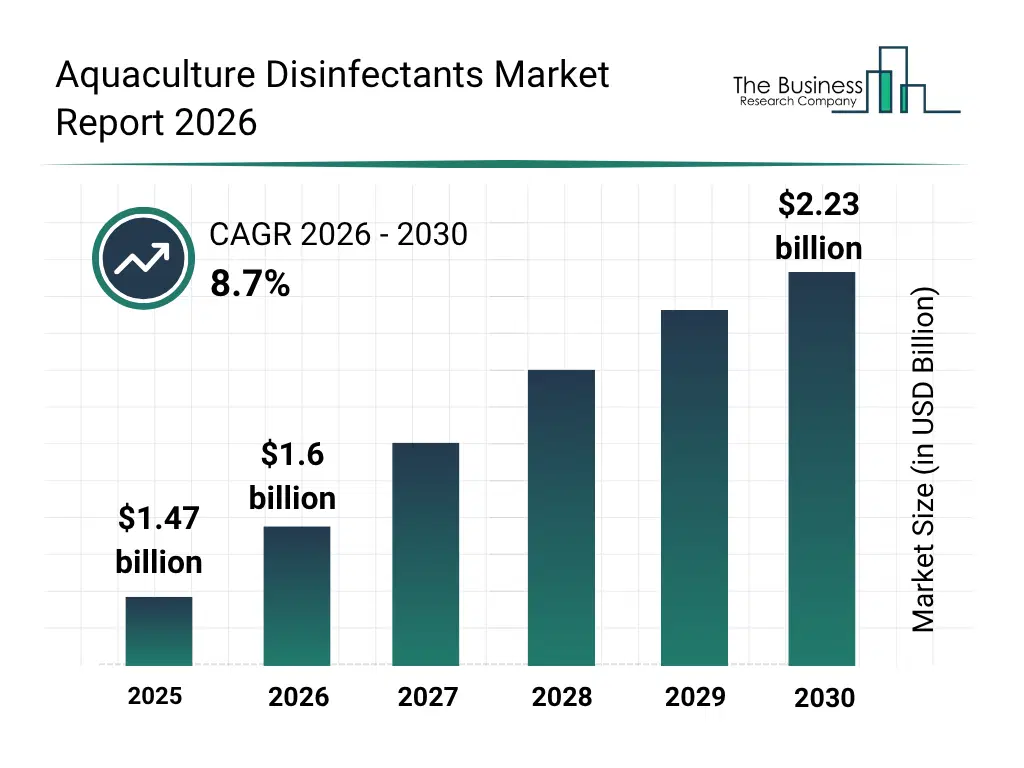
What Is The Aquaculture Disinfectants Market Size and Share 2026?
The aquaculture disinfectants market size has grown strongly in recent years. It will grow from $1.47 billion in 2025 to $1.6 billion in 2026 at a compound annual growth rate (CAGR) of 8.5%. The growth in the historic period can be attributed to increasing incidence of aquatic diseases, rising global fish consumption demand, expansion of commercial aquaculture farms, growing awareness of water hygiene in fish farming, increasing use of chemical disinfectants in hatcheries.What Is The Aquaculture Disinfectants Market Growth Forecast?
The aquaculture disinfectants market size is expected to see strong growth in the next few years. It will grow to $2.23 billion by 2030 at a compound annual growth rate (CAGR) of 8.7%. The growth in the forecast period can be attributed to growing adoption of sustainable aquaculture practices, increasing demand for seafood protein globally, rising investment in aquaculture biosecurity systems, expansion of intensive farming systems, growing innovation in low-toxicity disinfectant formulations. Major trends in the forecast period include increasing adoption of eco-friendly disinfectant formulations in aquaculture systems, rising use of oxidizing disinfectants for waterborne pathogen control, growing preference for non-toxic and fish-safe chemical solutions, expansion of shrimp and fish farming disease prevention programs, increasing use of automated dosing systems in aquaculture sanitation.Global Aquaculture Disinfectants Market Segmentation
1) By Type: Oxidizing Disinfectants, Non-Oxidizing Disinfectants, Aldehyde Disinfectants, Halogen Disinfectants, Other Types 2) By Form: Liquid, Powder, Granular, Other Forms 3) By Distribution Channel: Direct Sales, Distributors, Online Retail, Other Distribution Channels 4) By Application: Fish Farming, Shrimp Farming, Mollusk Farming, Other Applications 5) By End-Use: Commercial Aquaculture, Household And Small-Scale Aquaculture, Research And Educational Institutes, Other End-Uses Subsegments: 1) By Oxidizing Disinfectants: Hydrogen Peroxide Based Disinfectants, Peracetic Acid Based Disinfectants, Ozone Based Disinfectants, Potassium Permanganate Based Disinfectants, Chlorine Dioxide Based Disinfectants 2) By Non-Oxidizing Disinfectants: Quaternary Ammonium Compound Based Disinfectants, Biguanide Based Disinfectants, Phenolic Compound Based Disinfectants, Organic Acid Based Disinfectants, Alcohol Based Disinfectants 3) By Aldehyde Disinfectants: Formaldehyde Based Disinfectants, Glutaraldehyde Based Disinfectants, Ortho Phthalaldehyde Based Disinfectants, Glyoxal Based Disinfectants 4) By Halogen Disinfectants: Chlorine Based Disinfectants, Iodine Based Disinfectants, Bromine Based Disinfectants, Hypochlorite Based Disinfectants 5) By Other Types: Enzyme Based Disinfectants, Herbal Extract Based Disinfectants, Silver Based Disinfectants, Copper Based Disinfectants, Combined Formulation DisinfectantsWhat Is The Driver Of The Aquaculture Disinfectants Market?
The increasing demand for seafood is expected to propel the growth of the aquaculture disinfectants market going forward. Seafood refers to any edible aquatic animals and plants from the water that are consumed by humans, which serve as a major source of high-quality protein and minerals in the human diet. The demand for seafood is rising due to increasing health consciousness among consumers, as more people seek nutritious, protein-rich foods that support a balanced and healthy diet. Aquaculture disinfectants help seafood production by maintaining water quality, preventing disease outbreaks, and reducing microbial contamination, ensuring healthier aquatic species and safer, higher-quality seafood for consumption. For instance, in December 2024, according to the Marine Management Organization, a UK-based executive non-departmental public body, UK vessels landed 719,000 tones of sea fish in 2023, valued at $1.47 billion (£1.1 billion), representing a 12% increase in quantity and a 5% rise in value compared to 2022. Therefore, the increasing demand for seafood is driving the growth of the aquaculture disinfectant industry.Key Players In The Global Aquaculture Disinfectants Market
Major companies operating in the aquaculture disinfectants market are Merck KGaA, Bayer AG, Evonik Industries AG, Ecolab Inc, LANXESS AG, Solvay SA, Stepan Company, Veolia Water Technologies, Kemin Industries Inc, Christeyns NV, Shepard Bros Inc, Biosafe Systems LLC, Aditya Birla Chemicals, Kersia Group, Evans Vanodine International PLC, Virox Technologies Inc, Chemtex Speciality Ltd, Seitz GmbH, Fink Tec GmbH, Sanosil AG, AquaClean Environmental Products, Airedale Chemical Company Ltd.Global Aquaculture Disinfectants Market Trends and Insights
Major companies operating in the aquaculture disinfectants market are focusing on developing innovative products, such as peracetic acid-based biocides, to ensure safe and effective pathogen control while minimizing environmental impact. Peracetic acid-based biocides are disinfectants that quickly eliminate bacteria and viruses in water, breaking down into harmless byproducts, maintaining safe aquaculture conditions, supporting fish health, and reducing environmental impact. For instance, in May 2023, Evonik Industries AG, a Germany-based specialty chemicals company, launched Vigorox Trident, a peracetic acid biocide formulation designed for use in aquaculture. The product can be applied directly in tanks or ponds without removing fish, maintaining water quality while minimizing chemical residues. Vigorox Trident is effective at controlling fish pathogens, including bacteria and viruses, and supports high-density fish farming in sustainable recirculating systems. Its rapid breakdown into non-toxic components reduces environmental impact and eliminates additional cleaning steps, offering both operational efficiency and regulatory compliance benefits.What Are Latest Mergers And Acquisitions In The Aquaculture Disinfectants Market?
In May 2024, Steen Hansen AS, a Norway-based provider of advanced aquaculture net protection, partnered with Ecolab Inc. to enhance fish welfare and optimize aquaculture operations. With this collaboration, Steen Hansen AS and Ecolab Inc. aim to further develop and implement Steen Hansen’s NetCare program to jointly address fish health, reduce cross-contamination, and strengthen biosecurity across the aquaculture sector, helping improve net hygiene and promote sustainable, effective fish farming practices. Ecolab Inc. is a US-based chemicals company that specializes in providing hygiene and disinfection solutions for the aquaculture industry.Regional Insights
Asia-Pacific was the largest region in the aquaculture disinfectants market in 2025. North America is expected to be the fastest-growing region in the forecast period. The regions covered in this market report are Asia-Pacific, South East Asia, Western Europe, Eastern Europe, North America, South America, Middle East, Africa. The countries covered in this market report are Australia, Brazil, China, France, Germany, India, Indonesia, Japan, Taiwan, Russia, South Korea, UK, USA, Canada, Italy, Spain.What Defines the Aquaculture Disinfectants Market?
The aquaculture disinfectants market consists of sales of chlorine-based disinfectants, quaternary ammonium compounds, and heavy metal compounds. Values in this market are ‘factory gate’ values, that is, the value of goods sold by the manufacturers or creators of the goods, whether to other entities (including downstream manufacturers, wholesalers, distributors, and retailers) or directly to end customers. The value of goods in this market includes related services sold by the creators of the goods.How is Market Value Defined and Measured?
The market value is defined as the revenues that enterprises gain from the sale of goods and/or services within the specified market and geography through sales, grants, or donations in terms of the currency (in USD unless otherwise specified). The revenues for a specified geography are consumption values that are revenues generated by organizations in the specified geography within the market, irrespective of where they are produced. It does not include revenues from resales along the supply chain, either further along the supply chain or as part of other products.What Key Data and Analysis Are Included in the Aquaculture Disinfectants Market Report 2026?
The aquaculture disinfectants market research report is one of a series of new reports from The Business Research Company that provides market statistics, including industry global market size, regional shares, competitors with the market share, detailed market segments, market trends and opportunities, and any further data you may need to thrive in the aquaculture disinfectants industry. The market research report delivers a complete perspective of everything you need, with an in-depth analysis of the current and future state of the industry.Aquaculture Disinfectants Market Report Forecast Analysis
| Report Attribute | Details |
|---|---|
| Market Size Value In 2026 | $1.6 billion |
| Revenue Forecast In 2035 | $2.23 billion |
| Growth Rate | CAGR of 8.5% from 2026 to 2035 |
| Base Year For Estimation | 2025 |
| Actual Estimates/Historical Data | 2020-2025 |
| Forecast Period | 2026 - 2030 - 2035 |
| Market Representation | Revenue in USD Billion and CAGR from 2026 to 2035 |
| Segments Covered | Type, Form, Distribution Channel, Application, End-Use |
| Regional Scope | Asia-Pacific, Western Europe, Eastern Europe, North America, South America, Middle East, Africa |
| Country Scope | The countries covered in the report are Australia, Brazil, China, France, Germany, India, ... |
| Key Companies Profiled | Merck KGaA, Bayer AG, Evonik Industries AG, Ecolab Inc, LANXESS AG, Solvay SA, Stepan Company, Veolia Water Technologies, Kemin Industries Inc, Christeyns NV, Shepard Bros Inc, Biosafe Systems LLC, Aditya Birla Chemicals, Kersia Group, Evans Vanodine International PLC, Virox Technologies Inc, Chemtex Speciality Ltd, Seitz GmbH, Fink Tec GmbH, Sanosil AG, AquaClean Environmental Products, Airedale Chemical Company Ltd. |
| Customization Scope | Request for Customization |
| Pricing And Purchase Options | Explore Purchase Options |