
Anti Sniper Detection System For Defense Market Report 2026
Global Outlook – By Component (Sensors, Software), By System Type (Portable Systems, Fixed Systems, Mobile Systems, Remote Systems, Stationary Systems), By Technology (Acoustic Detection Systems, Radar Detection Systems, Infrared Detection Systems, Laser Detection Systems), By Application (Perimeter Intrusion And Camp Detection, Border Protection And Control, Critical Infrastructure Detection, VIP And Convoy Protection, ISR And Target Acquisition, Commercial And Office Spaces, Hospital Emergency Entrances, Sport Venues, Other Applications), By End User (Military, Law Enforcement And Homeland Security, Commercial, Government Agencies, Private Security Firms) – Market Size, Trends, Strategies, and Forecast to 2035
Anti Sniper Detection System For Defense Market Overview
• Anti Sniper Detection System For Defense market size has reached to $1.03 billion in 2025 • Expected to grow to $1.63 billion in 2030 at a compound annual growth rate (CAGR) of 9.8% • Growth Driver: Surge In Cross-border Security Threats Fueling The Growth Of The Market Due To Rising Illegal Migration And Border Risks • Market Trend: Advanced Acoustic Detection Improves Accuracy And Reduces False Positives • Asia-Pacific was the largest region in 2025 and North America is the fastest growing region.
What Is Covered Under Anti Sniper Detection System For Defense Market?
An anti-sniper detection system for defense is an advanced surveillance solution that detects, locates, and tracks hostile gunfire in real time using acoustic, optical, or infrared sensors. It quickly determines the source and trajectory of shots, enhancing situational awareness for security forces. These systems enable rapid response and better tactical decision-making in high-risk environments, help reduce casualties, and improve overall force protection. The main components of anti-sniper detection systems for defense are sensors and software. Sensors refer to devices that detect and locate sniper activity through acoustic, radar, infrared, or laser signals. These systems are categorized by system type, including portable systems, fixed systems, mobile systems, remote systems, and stationary systems, and utilize various technologies, such as acoustic detection systems, radar detection systems, infrared detection systems, and laser detection systems. They are applied across multiple applications, including perimeter intrusion and camp detection, border protection and control, critical infrastructure detection, VIP and convoy protection, ISR and target acquisition, commercial and office spaces, hospital emergency entrances, sport venues, and other applications, and serve different end-users, such as military, law enforcement and homeland security, commercial, government agencies, and private security firms.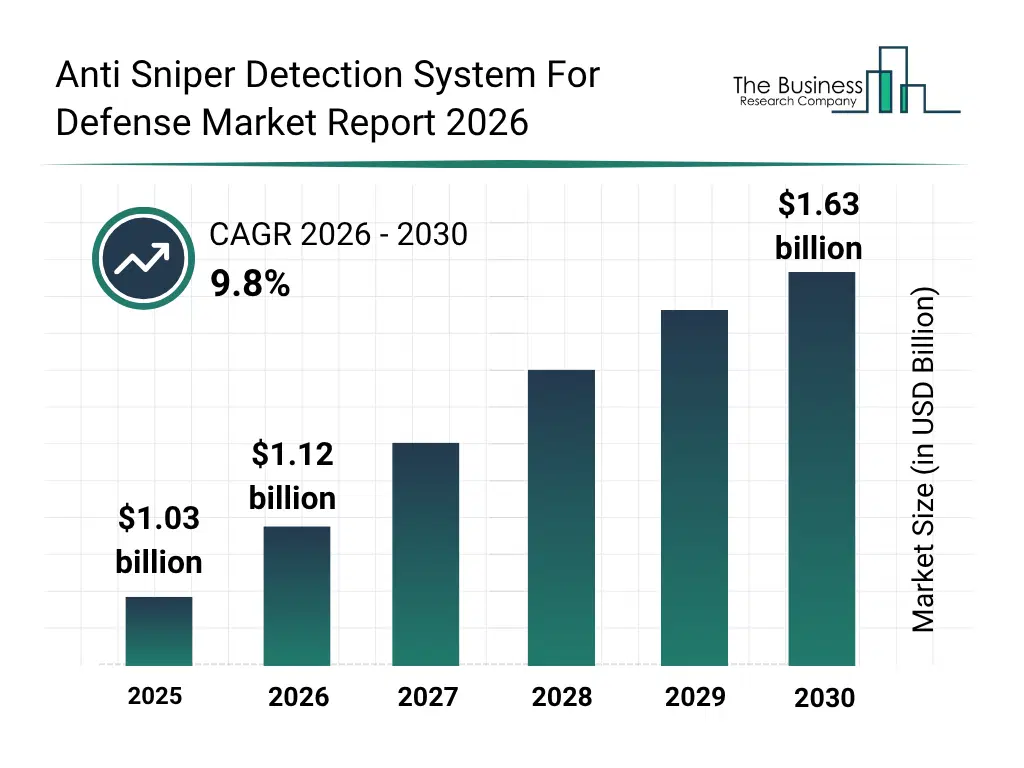
What Is The Anti Sniper Detection System For Defense Market Size and Share 2026?
The anti sniper detection system for defense market size has grown strongly in recent years. It will grow from $1.03 billion in 2025 to $1.12 billion in 2026 at a compound annual growth rate (CAGR) of 9.5%. The growth in the historic period can be attributed to increasing cross-border security threats, rising military modernization programs, growing insurgency and conflict zones, adoption of basic acoustic gunshot detection systems, expansion of defense surveillance infrastructure.What Is The Anti Sniper Detection System For Defense Market Growth Forecast?
The anti sniper detection system for defense market size is expected to see strong growth in the next few years. It will grow to $1.63 billion by 2030 at a compound annual growth rate (CAGR) of 9.8%. The growth in the forecast period can be attributed to increasing adoption of AI-enabled threat detection systems, rising demand for autonomous battlefield awareness platforms, growing investment in smart defense infrastructure, expansion of integrated ISR capabilities, increasing need for rapid response and force protection systems. Major trends in the forecast period include increasing adoption of multi-sensor fusion detection systems, rising demand for real-time ballistic trajectory analysis solutions, growing deployment of mobile and portable anti-sniper systems, expansion of border surveillance and perimeter security applications, rising integration of automated threat alert and response systems.Global Anti Sniper Detection System For Defense Market Segmentation
1) By Component: Sensors, Software 2) By System Type: Portable Systems, Fixed Systems, Mobile Systems, Remote Systems, Stationary Systems 3) By Technology: Acoustic Detection Systems, Radar Detection Systems, Infrared Detection Systems, Laser Detection Systems 4) By Application: Perimeter Intrusion And Camp Detection, Border Protection And Control, Critical Infrastructure Detection, VIP And Convoy Protection, ISR And Target Acquisition, Commercial And Office Spaces, Hospital Emergency Entrances, Sport Venues, Other Applications 5) By End User: Military, Law Enforcement And Homeland Security, Commercial, Government Agencies, Private Security Firms Subsegments: 1) By Sensors: Acoustic Sensors, Optical Sensors, Infrared Sensors, Laser Sensors, Radar Sensors 2) By Software: Threat Analysis Software, Target Tracking Software, Perimeter Monitoring Software, Alert Management Software, Data Fusion SoftwareWhat Is The Driver Of The Anti Sniper Detection System For Defense Market?
The increasing cross-border security threats are expected to propel the growth of the anti-sniper detection system for the defense market going forward. Cross-border security threats refer to risks and challenges arising from unauthorized or illegal activities across national borders that can compromise a country’s safety, economy, or sovereignty. The rise in cross-border security threats is driven by increased illegal migration, as it strains border enforcement and heightens risks of smuggling, trafficking, and other illicit activities. The anti-sniper detection system for defense helps address cross-border security threats by quickly detecting and locating hostile shooters, enhancing border protection, safeguarding personnel, and preventing potential attacks in sensitive areas. For instance, in September 2024, according to the Congress government, a US-based government department, in FY2023, U.S. Customs and Border Protection recorded 2,475,669 migrant encounters at the southwest border, the highest number on record. Therefore, increasing cross-border security threats are driving the growth of the anti-sniper detection system for the defense market.Key Players In The Global Anti Sniper Detection System For Defense Market
Major companies operating in the anti-sniper detection system for defense market are RTX Corporation, Lockheed Martin Corporation, General Dynamics Corporation, Northrop Grumman Corporation, BAE Systems plc, Safran Electronics & Defense, Thales Group, L3Harris Technologies Inc., Leonardo S.p.A., Textron Inc., Rheinmetall AG, Battelle Memorial Institute, Elbit Systems Ltd., Israel Aerospace Industries Ltd., Saab AB, Kongsberg Gruppen ASA, ASELSAN A.Ş., HENSOLDT AG, QinetiQ Group plc, Acoem Group, Transvaro Elektron Aletleri Sanayi ve Ticaret A.Ş., Rafael Advanced Defense Systems Ltd., Databuoy Corporation, Microflown AVISA B.V.Global Anti Sniper Detection System For Defense Market Trends and Insights
Major companies operating in the anti-sniper detection system for the defense market are focusing on developing advanced AI-powered acoustic threat detection solutions to enhance threat detection accuracy, reduce false positives, and improve response times in high-risk environments. AI-powered acoustic threat detection is a technology that uses sound sensors and artificial intelligence algorithms to identify, classify, and precisely locate threats such as gunshots in real time. For instance, in April 2025, Acoem ATD, a US-based provider of defense and public security technologies, unveiled its next-generation AI-powered gunshot detection system at ISC West 2025. The system combines a single ATD-300 sensor with Cadence software to provide instantaneous camera slewing toward detected threats, continuous AI learning to reduce false positives, and precise localization of both muzzle blasts and ballistic sound waves, setting a new standard for situational awareness and rapid response in military, law enforcement, and critical infrastructure applications.What Are Latest Mergers And Acquisitions In The Anti Sniper Detection System For Defense Market?
In January 2026, DroneVerse Aviation Pvt. Ltd., an India-based drone service provider, entered into a partnership with Triangula to co-develop an AI-enabled gunshot detection and autonomous drone response system for defense use. Through this collaboration, the companies aim to enhance battlefield situational awareness and rapid response capabilities by integrating advanced acoustic threat detection with autonomous UAV deployment. The system detects and classifies sniper and small-arms fire, triangulates the source within seconds, and deploys drones to provide real-time intelligence, aligning closely with anti-sniper detection system applications in defense. Triangula is an India-based provider of gunshot detection systems using mobile phones.Regional Insights
Asia-Pacific was the largest region in the anti-sniper detection system for defense market in 2025. North America is expected to be the fastest-growing region in the forecast period. The regions covered in this market report are Asia-Pacific, South East Asia, Western Europe, Eastern Europe, North America, South America, Middle East, Africa. The countries covered in this market report are Australia, Brazil, China, France, Germany, India, Indonesia, Japan, Taiwan, Russia, South Korea, UK, USA, Canada, Italy, Spain.What Defines the Anti Sniper Detection System For Defense Market?
The anti-sniper detection system for the defense market consists of revenues earned by entities by providing services such as threat alert notifications, system integration and deployment support, maintenance and calibration services, training, and simulation support. The market value includes the value of related goods sold by the service provider or included within the service offering. The anti-sniper detection system for defense market also includes sales of mounting equipment, tracking modules, and communication devices. Values in this market are ‘factory gate’ values, that is, the value of goods sold by the manufacturers or creators of the goods, whether to other entities (including downstream manufacturers, wholesalers, distributors, and retailers) or directly to end customers. The value of goods in this market includes related services sold by the creators of the goods.How is Market Value Defined and Measured?
The market value is defined as the revenues that enterprises gain from the sale of goods and/or services within the specified market and geography through sales, grants, or donations in terms of the currency (in USD unless otherwise specified). The revenues for a specified geography are consumption values that are revenues generated by organizations in the specified geography within the market, irrespective of where they are produced. It does not include revenues from resales along the supply chain, either further along the supply chain or as part of other products.What Key Data and Analysis Are Included in the Anti Sniper Detection System For Defense Market Report 2026?
The anti sniper detection system for defense market research report is one of a series of new reports from The Business Research Company that provides market statistics, including industry global market size, regional shares, competitors with the market share, detailed market segments, market trends and opportunities, and any further data you may need to thrive in the anti sniper detection system for defense industry. The market research report delivers a complete perspective of everything you need, with an in-depth analysis of the current and future state of the industry.Anti Sniper Detection System For Defense Market Report Forecast Analysis
| Report Attribute | Details |
|---|---|
| Market Size Value In 2026 | $1.12 billion |
| Revenue Forecast In 2035 | $1.63 billion |
| Growth Rate | CAGR of 9.5% from 2026 to 2035 |
| Base Year For Estimation | 2025 |
| Actual Estimates/Historical Data | 2020-2025 |
| Forecast Period | 2026 - 2030 - 2035 |
| Market Representation | Revenue in USD Billion and CAGR from 2026 to 2035 |
| Segments Covered | Component, System Type, Technology, Application, End User |
| Regional Scope | Asia-Pacific, Western Europe, Eastern Europe, North America, South America, Middle East, Africa |
| Country Scope | The countries covered in the report are Australia, Brazil, China, France, Germany, India, ... |
| Key Companies Profiled | RTX Corporation, Lockheed Martin Corporation, General Dynamics Corporation, Northrop Grumman Corporation, BAE Systems plc, Safran Electronics & Defense, Thales Group, L3Harris Technologies Inc., Leonardo S.p.A., Textron Inc., Rheinmetall AG, Battelle Memorial Institute, Elbit Systems Ltd., Israel Aerospace Industries Ltd., Saab AB, Kongsberg Gruppen ASA, ASELSAN A.Ş., HENSOLDT AG, QinetiQ Group plc, Acoem Group, Transvaro Elektron Aletleri Sanayi ve Ticaret A.Ş., Rafael Advanced Defense Systems Ltd., Databuoy Corporation, Microflown AVISA B.V. |
| Customization Scope | Request for Customization |
| Pricing And Purchase Options | Explore Purchase Options |